

Introduction
Artificial intelligence often appears mysterious to beginners. News headlines describe powerful AI models, automation systems, and machines capable of generating text, images, and predictions.
But behind these advanced applications lies a process that is much easier to understand than most people expect.
Artificial intelligence works by analyzing data, identifying patterns, and making predictions based on those patterns. Instead of relying entirely on instructions written by programmers, AI systems learn from examples.
If you have ever used a recommendation system, voice assistant, or navigation app, you have already interacted with artificial intelligence in action.
These systems analyze enormous amounts of information to recognize patterns and generate useful responses.
Understanding how artificial intelligence works helps beginners move beyond hype and see the real structure behind AI technologies. Once the process becomes clear, concepts like machine learning, neural networks, and model training start to make practical sense.
To understand how AI systems operate, it helps to break the process into a few key stages.
The Core Idea Behind Artificial Intelligence
At its core, artificial intelligence is about pattern recognition.
Traditional software relies on explicit rules written by developers. If a program needs to perform a task, programmers must define every possible instruction.
Artificial intelligence takes a different approach.
Instead of writing rules for every situation, developers allow the system to learn patterns from data. The model studies examples and gradually improves its ability to recognize relationships between inputs and outputs.
For example, imagine teaching a computer to recognize pictures of dogs.
A traditional program would require thousands of manually written rules describing every possible shape, color, and feature of a dog. This approach quickly becomes impractical.
An AI system works differently.
Developers provide a large dataset containing thousands of labeled images of dogs and other animals. The system analyzes these examples and identifies patterns that frequently appear when an image contains a dog.
Over time, the model learns which visual features are most useful for identifying that category.
When the trained model encounters a new image, it compares the patterns it learned during training and predicts whether the image likely contains a dog.
This process does not involve true understanding. It relies on statistical prediction based on patterns observed in data.
Once beginners understand this core idea, the next step is examining the key components that make the AI learning process possible.
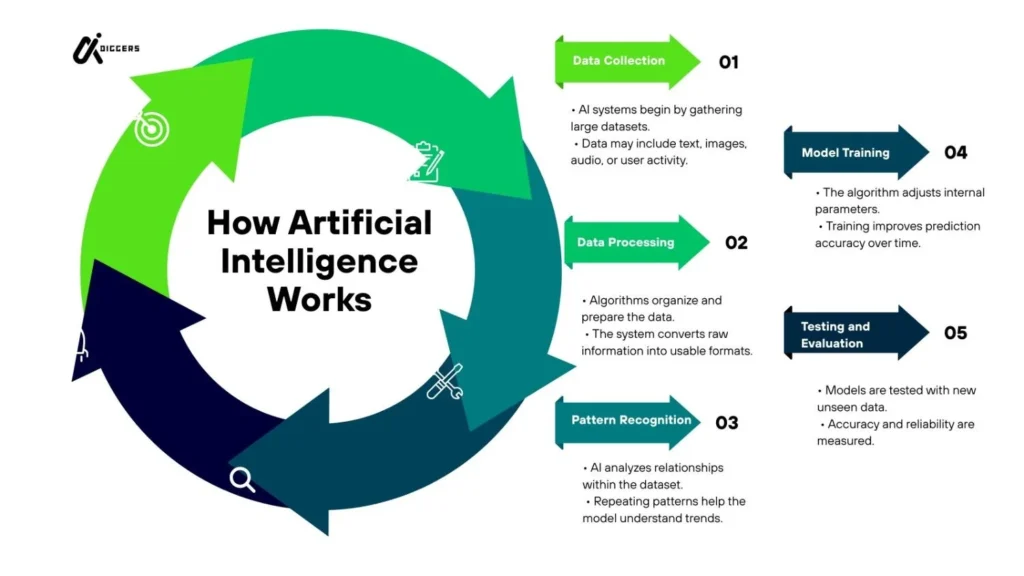
The Key Components That Make AI Work
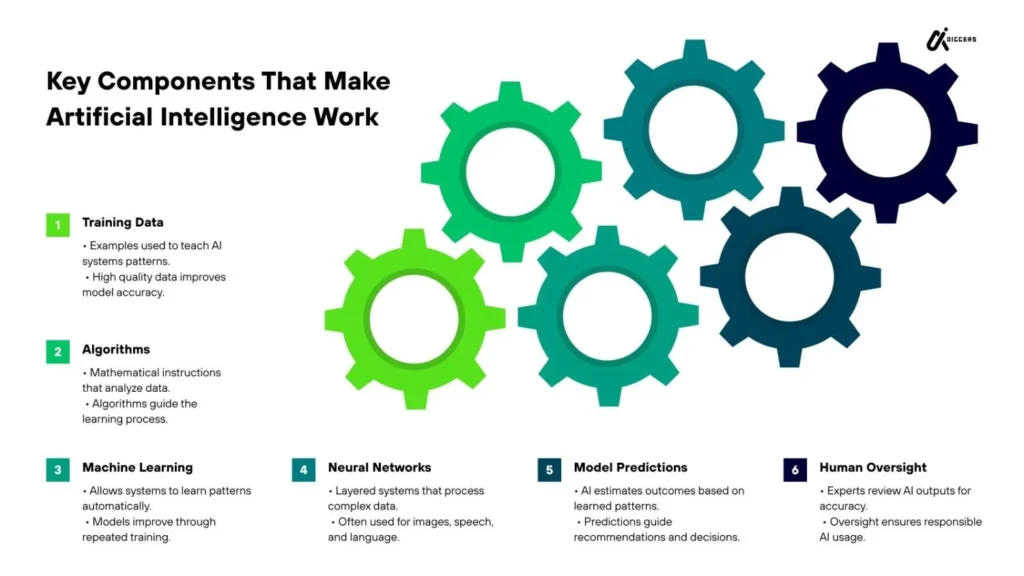
Although artificial intelligence systems can become very complex, most of them rely on the same foundational components. These elements work together to allow machines to learn patterns and generate predictions.
Understanding these building blocks makes the entire AI process easier to visualize.
Data
Data is the foundation of every AI system.
Without data, an artificial intelligence model has nothing to learn from. Data provides the examples that allow the system to recognize patterns and build predictive models.
Data used in AI training can include:
• text documents
• images and videos
• audio recordings
• numerical datasets
• user behavior patterns
• sensor readings
For example, a speech recognition system must analyze thousands of hours of recorded speech before it can accurately convert spoken language into text.
The diversity and quality of the data strongly influence how well the system performs.
Algorithms
Algorithms are structured instructions that guide how the system processes data.
In artificial intelligence, algorithms determine how patterns are discovered inside datasets and how the model adjusts its predictions during training.
Different algorithms are designed for different tasks. Some classify information into categories. Others predict numerical outcomes or detect unusual behavior in data.
The algorithm acts as the analytical engine that drives the learning process.
Models
A model is the result of training an algorithm on data.
During training, the system analyzes examples and builds a mathematical representation of the patterns it discovered. This representation becomes the trained model.
Once trained, the model can evaluate new information and generate predictions based on what it learned from the training data.
For example, a recommendation model may analyze past user behavior and predict which products or movies a person is most likely to enjoy.
Training
Training is the process where the AI system learns from data.
During training, the model repeatedly analyzes examples from the dataset and compares its predictions with the correct answers. The difference between prediction and reality is measured as error.
The system then adjusts internal parameters to reduce that error.
This process repeats many times until the model improves its accuracy.
Training allows AI systems to improve their performance over time rather than relying on fixed instructions.
How Machine Learning Powers Artificial Intelligence
Machine learning is the engine that powers most modern artificial intelligence systems. Instead of programming every rule manually, machine learning allows computers to learn patterns directly from data.
This approach changed how intelligent systems are built.
In traditional programming, developers write explicit instructions. If a system needs to recognize spam emails, programmers must define rules such as detecting certain words, suspicious links, or unusual formatting.
Machine learning takes a different approach.
Instead of writing all the rules, developers provide examples. The system studies those examples and learns the patterns automatically.
For instance, a spam detection model may analyze thousands of emails labeled as spam and legitimate messages. By examining these examples, the model learns which patterns commonly appear in spam messages.
When a new email arrives, the system analyzes its features and predicts whether it belongs to the spam category.
Machine learning models improve as they process more relevant data. The more examples they study, the better they become at recognizing patterns.
This approach is used across many industries, including:
• recommendation systems
• fraud detection
• language translation
• predictive analytics
• search engine ranking
Machine learning makes artificial intelligence scalable because systems can learn from large datasets instead of relying on manually written rules.
How Neural Networks Process Information
Neural networks are one of the most powerful tools used in modern artificial intelligence.
They are mathematical models designed to detect complex patterns in data. The name neural network comes from the way these systems are loosely inspired by the structure of the human brain.
A neural network is made of layers of connected computational units called nodes.
These layers typically include:
• an input layer
• one or more hidden layers
• an output layer
Each layer processes information and passes results to the next layer.
For example, in an image recognition system, the input layer receives the image data. The hidden layers analyze patterns such as edges, shapes, textures, and combinations of visual features.
As the information moves through the layers, the system gradually recognizes more complex patterns.
During training, the network adjusts internal parameters called weights. These adjustments reduce prediction errors and help the model improve its accuracy.
Deep learning is a specialized form of machine learning that uses neural networks with many hidden layers. These deep architectures are capable of analyzing very complex information such as natural language, images, and audio.
Deep learning models power many modern technologies including:
• speech recognition systems
• image classification tools
• autonomous vehicle perception
• large language models
• generative AI systems
Although neural networks can perform impressive tasks, they still rely entirely on data and training processes. They do not think or reason in the same way humans do.
How AI Systems Make Predictions
Prediction is the core function of artificial intelligence.
After a model is trained, it uses the patterns learned during training to evaluate new data and estimate the most likely outcome.
This prediction process happens extremely quickly and can analyze massive amounts of information.
Consider a recommendation system used by a streaming platform.
The model analyzes patterns such as:
• viewing history
• watch time
• user ratings
• behavior patterns from similar users
Based on these patterns, the system predicts which movies or shows a user may want to watch next.
The same prediction principle appears in many other applications.
Fraud detection systems analyze transaction patterns to estimate the likelihood of fraudulent activity. Navigation apps analyze traffic data to predict faster travel routes. Email filters analyze message patterns to determine whether an email is likely to be spam.
These predictions rely on probabilities rather than certainty.
A model estimates which outcome is most likely based on the patterns it learned during training. While predictions can be highly accurate, they are not always correct.
Understanding this probabilistic nature helps beginners interpret AI outputs more realistically.
Artificial intelligence systems provide predictions and recommendations, but human judgment is still essential when evaluating important decisions.
Real World Examples of How Artificial Intelligence Works
Artificial intelligence is already integrated into many tools and services that people use daily. Looking at real world examples makes the learning process much clearer for beginners.
Recommendation Systems
Streaming platforms and online stores use recommendation systems powered by machine learning.
These systems analyze user behavior such as viewing history, purchase patterns, and engagement data. By comparing these patterns with information from other users, the system predicts which content or products someone might find interesting.
This type of AI helps personalize digital experiences.
Voice Assistants
Voice assistants rely on multiple AI technologies working together.
Speech recognition models convert spoken audio into text. Natural language processing systems analyze the meaning of the request. Finally, a response generation system produces an appropriate answer or action.
This combination of technologies allows users to interact with devices using natural language.
Image Recognition
Computer vision systems analyze images and video frames to identify objects and patterns.
Smartphone cameras use image recognition to detect faces automatically. Security systems use it to monitor environments. Medical imaging tools use AI to help identify patterns that may indicate disease.
These systems rely heavily on deep learning models trained on large image datasets.
Fraud Detection
Financial institutions use AI to monitor transaction activity.
Machine learning models analyze spending patterns and detect unusual behavior that may indicate fraud. If a transaction appears inconsistent with a user’s typical activity, the system may flag it for further review.
This helps organizations detect suspicious activity much faster than manual monitoring.
Limitations of Artificial Intelligence Systems
Although artificial intelligence can analyze data and generate predictions efficiently, it also has important limitations.
Understanding these limitations helps beginners use AI responsibly.
Dependence on Training Data
AI systems depend entirely on the data used during training.
If the training data contains errors, gaps, or bias, the resulting model may produce unreliable predictions.
The accuracy of an AI system is strongly tied to the quality and diversity of its dataset.
AI Hallucinations
Generative AI systems sometimes produce responses that sound convincing but contain incorrect information.
This happens because the system predicts language patterns rather than verifying facts against a database.
For important decisions or research, AI outputs should always be verified using reliable sources.
Lack of Human Understanding
Artificial intelligence models can recognize patterns but they do not possess true understanding.
They do not have awareness, reasoning, or context in the way humans do. Their outputs are based on statistical prediction rather than comprehension.
Recognizing this limitation helps beginners interpret AI responses more carefully.
Key Takeaways
Artificial intelligence works by analyzing data, identifying patterns, and generating predictions based on those patterns.
Machine learning allows systems to learn from examples instead of relying on manually written rules. Neural networks and deep learning models expand these capabilities by analyzing complex data such as images, audio, and natural language.
During training, AI systems study large datasets and adjust internal parameters to improve prediction accuracy. Once trained, these models can evaluate new information and estimate likely outcomes.
Artificial intelligence already powers many technologies including recommendation systems, voice assistants, fraud detection tools, and image recognition systems.
At the same time, AI systems have limitations. They depend heavily on data quality, can produce incorrect predictions, and require human oversight for responsible use.
For beginners, understanding how artificial intelligence works provides a strong foundation for exploring more advanced AI topics.
FAQ
How does artificial intelligence work in simple terms?
Artificial intelligence works by analyzing large amounts of data, identifying patterns, and using those patterns to make predictions or decisions.
What role does machine learning play in AI?
Machine learning allows AI systems to learn patterns from data instead of relying entirely on manually written rules.
How do AI models learn from data?
AI models learn through a training process where they analyze examples, compare predictions with correct answers, and adjust internal parameters to reduce errors.
What are neural networks in artificial intelligence?
Neural networks are mathematical models made of connected layers that analyze patterns in complex data such as images, text, and audio.
Why do AI systems make predictions instead of decisions?
AI systems estimate probabilities based on patterns learned during training. These predictions help guide decisions but do not replace human judgment.
Where is artificial intelligence used today?
AI is used in recommendation systems, voice assistants, fraud detection tools, image recognition systems, and many other technologies.
Can artificial intelligence think like humans?
No. AI systems recognize patterns and generate predictions but they do not possess human understanding or consciousness.
Why is data important in artificial intelligence?
Data provides the examples that AI systems use to learn patterns. The quality of training data strongly influences the accuracy of predictions.
Refrence: Wikipedia, Google Scholar