

Artificial intelligence sounds complex. Many beginners imagine advanced robots, complicated mathematics, and endless lines of code.
That image stops people before they even begin.
In reality, artificial intelligence starts with a simple idea.
Teaching machines to recognize patterns.
If you use a smartphone, search engine, streaming platform, navigation app, or online store, you are already interacting with AI systems. The difference is that most people use AI without understanding how it works.
What Is Artificial Intelligence for Beginners
If you strip away the technical language, artificial intelligence means this:
Systems that can perform tasks that normally require human intelligence.
These tasks may include:
• Recognizing speech
• Identifying images
• Predicting outcomes
• Translating languages
• Recommending products
• Generating text
Traditional software follows strict rules written by programmers.
AI systems learn patterns from data.
For example, instead of manually coding every possible spam email rule, an AI model analyzes thousands of examples of spam and non spam messages. It learns patterns and predicts future messages.
That process is powered by machine learning.
Artificial intelligence is the broad field. Machine learning is one of the main techniques inside it.
Why AI Matters Today
AI is now integrated into:
• Search engines
• Virtual assistants
• Social media feeds
• Recommendation systems
• Online advertising
• Fraud detection
• Healthcare diagnostics
• Business analytics
Companies use AI to automate repetitive tasks and improve decision making.
This shift creates new career opportunities. It also changes how people work in almost every industry.
Understanding AI is becoming part of digital literacy.
Even if you never become an AI engineer, understanding how AI systems operate helps you navigate modern technology responsibly.
AI vs Traditional Software
Traditional software works like a calculator.
You input a formula.
It follows predefined instructions.
It produces a result.
Artificial intelligence works differently.
You give it data.
It finds patterns.
It learns from examples.
It improves predictions over time.
That learning process depends on training data and algorithms.
If the training data is poor, the AI model performs poorly.
If the dataset is biased, the AI system may produce biased outcomes.
Understanding this difference prevents common beginner misconceptions.
Artificial intelligence is powerful, but it is not independent thinking. It is statistical prediction at scale.
How AI Works Explained Simply
When beginners hear words like neural networks, algorithms, or model training, the subject can feel intimidating.
But the core idea is simpler than it sounds.
Artificial intelligence works by learning patterns from data.
That is the foundation.
Instead of hard coding every possible rule, AI systems analyze large amounts of information and identify relationships inside it. Once trained, they use those learned patterns to make predictions on new data.
Let us break this down clearly.
Data, Algorithms, and Patterns
Every AI system starts with data.
Data can be:
• Images
• Text
• Audio
• Numbers
• User behavior
• Sensor readings
An algorithm is a set of instructions that tells the system how to analyze that data.
In traditional software, rules are fixed.
In AI, the algorithm adjusts itself based on patterns it finds in the training data.
For example:
If you show a model thousands of labeled images of cats and dogs, it learns patterns that distinguish the two. When you show it a new image, it predicts whether it matches the learned pattern of a cat or a dog.
This is pattern recognition.
The quality of training data directly affects the quality of predictions. If the data is incomplete or biased, the output may also be flawed.
What Is Machine Learning
Machine learning is a core branch of artificial intelligence.
Instead of programming rules manually, developers allow the system to learn from data.
There are three common learning types beginners should understand:
Supervised learning
The system learns from labeled examples. For instance, email messages labeled as spam or not spam.
Unsupervised learning
The system identifies patterns without labeled answers. It groups similar data points together.
Reinforcement learning
The system learns through trial and error by receiving rewards or penalties.
Machine learning models improve over time as they process more relevant data.
However, they do not understand meaning the way humans do. They calculate probabilities.
What Are Neural Networks
Neural networks are inspired by the human brain, but they are not biological brains.
They are mathematical systems made of connected layers of nodes.
Each layer processes information and passes results to the next layer. Through training, these networks adjust internal parameters to reduce errors in prediction.
Deep learning is a more advanced form of machine learning that uses many layered neural networks. It is often used in:
• Image recognition
• Speech processing
• Language generation
• Autonomous systems
Large language models are a type of deep learning system trained on vast amounts of text. They generate human like responses by predicting the next word based on patterns.
Again, prediction is not understanding.
That distinction is critical for beginners.
Training Data and Model Learning
Training is the phase where the model learns patterns.
During training:
• Data is fed into the model
• Predictions are compared with correct answers
• Errors are calculated
• The system adjusts its internal parameters
This process repeats thousands or millions of times.
Overfitting can occur if a model memorizes training data instead of learning general patterns. Underfitting happens if the model fails to learn meaningful patterns.
Model accuracy depends on:
• Data quality
• Dataset size
• Algorithm design
• Proper evaluation
Artificial intelligence is powerful because it scales pattern recognition. It is limited because it depends entirely on data and design choices.
Understanding this gives beginners clarity and realistic expectations.
Types of Artificial Intelligence
When beginners hear the term artificial intelligence, they often assume it refers to one single technology.
In reality, AI includes different categories based on capability and learning method.
Understanding these types prevents confusion and helps you navigate beginner resources more effectively.
Narrow AI
Narrow AI, also called weak AI, is the only form of AI that exists today.
It is designed to perform specific tasks.
Examples include:
• Spam filters
• Recommendation engines
• Voice assistants
• Image recognition systems
• Chat based AI tools
Narrow AI does not have general intelligence. It cannot transfer knowledge from one task to another unless it has been specifically trained for that purpose.
Most real world AI applications fall into this category.
General AI
General AI refers to a theoretical system that can perform any intellectual task a human can perform.
It would:
• Understand context deeply
• Apply knowledge across domains
• Reason abstractly
• Learn independently without narrow constraints
General AI does not currently exist.
When beginners read headlines suggesting machines are becoming conscious or fully intelligent, it is important to recognize that these claims refer to advanced narrow AI systems, not true general intelligence.
Generative AI
Generative AI creates new content.
It can generate:
• Text
• Images
• Audio
• Code
• Video
These systems rely heavily on deep learning and large language models. They analyze patterns from massive datasets and generate outputs based on probability.
Generative AI is powerful, but it can also produce inaccurate or misleading information. Beginners must treat generated content as a draft or assistant output, not as verified fact.
Supervised, Unsupervised, and Reinforcement Learning
Another way to classify AI is by how it learns.
Supervised learning uses labeled data. The system learns by comparing predictions with correct answers.
Unsupervised learning identifies hidden patterns without labeled outcomes. It is often used in clustering and anomaly detection.
Reinforcement learning improves performance through rewards and penalties. It is common in robotics and game playing systems.
These learning types form the foundation of many AI applications.
Understanding them helps beginners see that AI is not one single tool. It is a collection of techniques built around pattern recognition and optimization.
Real World AI Examples for Beginners
Many beginners understand artificial intelligence only when they see it in action.
The easiest way to remove confusion is to look at real world examples.
AI is not hidden in laboratories. It is part of daily life.
AI in Daily Life
You interact with AI more often than you realize.
When you unlock your phone using facial recognition, a computer vision model identifies patterns in your face.
When a streaming platform recommends movies, a machine learning system analyzes your viewing history and predicts what you may like next.
When you type a message and your phone suggests the next word, a language model predicts the most probable continuation.
Navigation apps analyze traffic data to recommend faster routes. Email systems filter spam using supervised learning models trained on labeled messages.
These are examples of narrow AI solving specific tasks efficiently.
AI in Business
Businesses use AI to improve efficiency and decision making.
Examples include:
• Fraud detection systems in banking
• Customer support chat systems
• Demand forecasting in retail
• Marketing personalization
• Supply chain optimization
• Risk analysis in finance
In these cases, AI processes large datasets faster than humans and identifies patterns that support better decisions.
However, human oversight remains essential. AI assists analysis but does not replace accountability.
AI in Education
Educational technology platforms use AI for:
• Adaptive learning paths
• Automated grading assistance
• Personalized tutoring systems
• Content recommendation
• Performance analytics
These systems analyze student responses and adjust content accordingly.
AI does not replace teachers. It supports classroom integration and learning optimization.
AI in Healthcare
Healthcare applications include:
• Medical image analysis
• Disease risk prediction
• Drug discovery research
• Administrative automation
• Patient monitoring systems
These systems help professionals detect patterns that might be difficult to identify manually.
However, medical AI systems require strict validation and regulatory approval. They assist doctors, not replace them.
AI in Automation and Industry
In manufacturing and logistics, AI supports:
• Quality control inspection
• Predictive maintenance
• Robotics automation
• Route optimization
Sensors collect data. Machine learning models analyze it. Businesses reduce downtime and improve productivity.
Artificial Intelligence vs Machine Learning vs Deep Learning
Beginners often use these terms interchangeably.
Artificial intelligence.
Machine learning.
Deep learning.
They are related, but they are not the same.
Understanding the difference gives you clarity when choosing courses, reading tutorials, or planning a career path.
Artificial Intelligence: The Broad Field
Artificial intelligence is the umbrella term.
It refers to any system designed to perform tasks that normally require human intelligence.
This includes:
• Rule based expert systems
• Machine learning models
• Neural networks
• Robotics
• Natural language processing systems
AI is the broad category.
Machine learning and deep learning are techniques inside AI.
Machine Learning: Learning from Data
Machine learning is a subset of artificial intelligence.
Instead of writing explicit rules, developers train models on data.
For example:
Rather than programming every rule for identifying spam emails, a machine learning model analyzes thousands of examples and learns patterns automatically.
Machine learning focuses on:
• Classification
• Regression
• Pattern recognition
• Predictive modeling
It relies heavily on training data and algorithms.
Most modern AI applications use machine learning in some form.
Deep Learning: Advanced Neural Networks
Deep learning is a specialized area within machine learning.
It uses artificial neural networks with many layers. These layered structures allow systems to analyze complex data such as images, audio, and natural language.
Deep learning powers:
• Image recognition systems
• Speech recognition
• Generative AI models
• Large language models
• Autonomous vehicles
Deep learning models require large datasets and significant computational resources.
They are powerful, but they are also complex and resource intensive.
Where Data Science Fits
Data science overlaps with artificial intelligence and machine learning.
Data science focuses on:
• Data collection
• Data cleaning
• Statistical analysis
• Visualization
• Model evaluation
AI systems depend on high quality data science practices.
Without clean, structured, and representative datasets, machine learning models perform poorly.
Why These Terms Are Often Confused
The confusion happens because:
• Companies use the term AI for marketing
• Media headlines simplify technical language
• Tools combine multiple techniques under one label
For beginners, the important takeaway is simple:
Artificial intelligence is the broad concept.
Machine learning is a method used inside AI.
Deep learning is an advanced method inside machine learning.
Can You Learn AI Without Coding or Math
This is one of the most common beginner questions.
Do I need to know programming
Do I need advanced mathematics
Is AI only for engineers
The honest answer depends on your goal.
If your goal is to build AI systems from scratch, then yes, programming and mathematics are essential.
If your goal is to understand AI, use AI tools, or integrate AI into business workflows, you can start without coding.
Let us break this down clearly.
AI for Non Programmers
Many people interact with AI tools daily without writing a single line of code.
For example:
• Using AI writing assistants
• Generating images with AI tools
• Building automation workflows using no code platforms
• Analyzing data with AI powered dashboards
Understanding how to use AI effectively does not require deep programming knowledge.
What it requires is:
• Clear communication skills
• Logical thinking
• Awareness of AI limitations
• Basic digital literacy
Non technical professionals in marketing, business, design, and education are already integrating AI into their work.
This is why AI literacy is becoming valuable beyond engineering.
AI Without Coding Tools
There are platforms that allow users to experiment with AI models through graphical interfaces.
These platforms may offer:
• Drag and drop model builders
• Pre built AI APIs
• Automated data analysis tools
• No code automation systems
These tools help beginners understand AI concepts without diving into algorithms immediately.
However, understanding the underlying principles still matters. Even if you do not code, you should understand:
• What training data is
• How models learn
• What bias means
• Why outputs can be incorrect
When Programming Becomes Necessary
If you want to:
• Build custom AI models
• Train neural networks
• Develop machine learning systems
• Work as an AI engineer
Then programming becomes essential.
Languages commonly associated with AI include Python because of its strong ecosystem in machine learning and data science.
You will also need foundational knowledge in:
• Statistics
• Linear algebra
• Probability
• Algorithms
That does not mean you must master advanced mathematics immediately. Beginners can start with conceptual understanding and gradually deepen technical skills.
Common Beginner Misconceptions
Many beginners believe:
AI requires genius level math
AI is only for computer science students
AI cannot be understood without coding
AI systems are always accurate
These assumptions are incorrect.
AI is complex, but it is structured. With consistent learning and realistic expectations, beginners can progress step by step.
The key is clarity about your objective.
Are you learning AI to understand it
To use it
Or to build it
Each path requires a different level of technical depth.
The next logical step is understanding how to start learning AI in a structured way.
How to Start Learning AI from Scratch
Most beginners make the same mistake.
They open ten browser tabs.
They watch random tutorials.
They try advanced topics too early.
They quit after two weeks.
Artificial intelligence is broad. Without structure, it feels overwhelming.
The solution is not speed.
The solution is sequencing.
You need a roadmap.
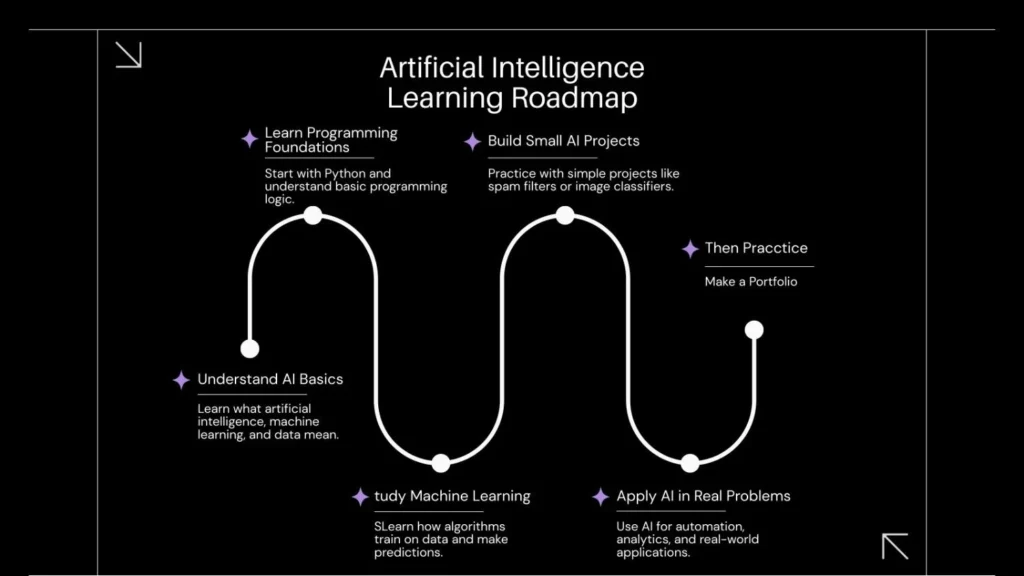
Step 1: Understand the Foundations
Before writing code or building models, understand the core concepts:
• What artificial intelligence is
• What machine learning means
• The difference between supervised and unsupervised learning
• What neural networks are
• How training data influences models
• What bias and limitations mean
This conceptual clarity prevents confusion later.
You do not need advanced math at this stage. Focus on understanding ideas.
Step 2: Learn Basic Programming
If your goal includes building AI systems, begin with programming fundamentals.
Python is widely used in machine learning because of its strong libraries and community support.
Start with:
• Variables
• Loops
• Functions
• Data structures
• Basic problem solving
Do not jump directly into neural networks. Build comfort with logic first.
If your goal is non technical AI literacy, you can delay this step and focus on using AI tools responsibly.
Step 3: Learn Core Machine Learning Concepts
Once you understand programming basics, move into:
• Data preprocessing
• Model training
• Model evaluation
• Overfitting and underfitting
• Model accuracy and validation
You should understand how datasets are split into training and testing sets.
At this stage, beginners often realize that data quality is more important than complex models.
Step 4: Explore Deep Learning and Neural Networks
After mastering machine learning fundamentals, you can explore:
• Artificial neural networks
• Deep learning frameworks
• Image recognition systems
• Natural language processing
• Generative AI models
This stage requires more time and patience.
Do not rush into advanced architectures without understanding the basics.
Step 5: Build Small Projects
Learning becomes real when you apply it.
Beginner project ideas:
• Simple spam classifier
• Image classification experiment
• Chat based assistant using existing APIs
• Basic predictive model using structured data
Projects reinforce concepts better than passive reading.
Alternative Path: AI Without Coding
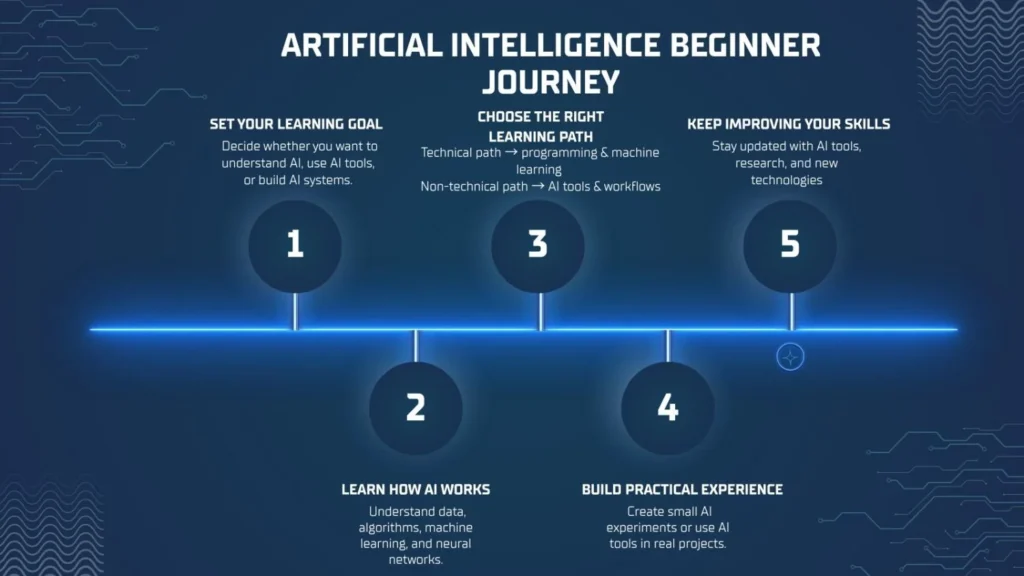
If your goal is practical AI literacy rather than engineering, your roadmap looks different:
• Understand how AI systems work
• Learn prompt clarity
• Study AI limitations
• Experiment with AI tools
• Learn automation workflows
• Understand ethical boundaries
This path is valuable for business professionals, marketers, educators, and content creators.
How Long Does It Take to Learn AI
The timeline depends on your goal.
If you want basic understanding, you can build conceptual clarity within a few months of consistent study.
If you want to become an AI engineer, it may take years of structured learning, including programming, mathematics, and real project experience.
Is AI Hard to Learn
This question usually comes from fear, not from experience.
Artificial intelligence has a reputation for being complex. Words like neural networks, algorithms, and data science make beginners assume it is extremely difficult.
The truth is more balanced.
AI is challenging, but it is learnable.
The difficulty depends on what you are trying to achieve.
Conceptual Understanding Is Not Hard
If your goal is to understand:
• What artificial intelligence is
• How machine learning works
• What generative AI does
• Where AI is used in daily life
Then AI is not difficult.
These concepts can be understood with structured learning and consistent practice. Many beginners struggle because they try to jump into advanced topics before building foundations.
Start with concepts. Build clarity. Move step by step.
Technical Depth Is More Demanding
If your goal is to:
• Build machine learning models
• Train neural networks
• Work with large datasets
• Optimize model performance
Then AI becomes more demanding.
You will need:
• Programming skills
• Statistical understanding
• Mathematical reasoning
• Problem solving ability
This path requires patience and structured study.
It is not impossible, but it is rigorous.
What Makes AI Feel Difficult
AI feels hard when:
• Beginners compare themselves to experts
• They try advanced frameworks too early
• They skip fundamentals
• They focus only on theory without projects
• They expect fast results
Artificial intelligence combines multiple fields including mathematics, programming, and data science. Without sequencing, it feels overwhelming.
With sequencing, it becomes manageable.
How to Make Learning Easier
To reduce difficulty:
• Follow a structured roadmap
• Focus on one concept at a time
• Build small projects early
• Review fundamentals regularly
• Avoid jumping between too many resources
Learning AI is like building layers.
Each layer supports the next.
Once beginners understand this, the next big question becomes clearer.
Is AI a Good Career Choice
Artificial intelligence is one of the most discussed fields in technology today. But discussion does not automatically mean suitability.
Before choosing AI as a career path, beginners should understand what the field actually involves.
AI careers are not limited to building robots or designing complex neural networks. The ecosystem is broader than many assume.
AI Career Paths
AI related careers may include:
• Machine learning engineer
• Data scientist
• AI researcher
• AI product manager
• AI consultant
• AI ethics specialist
• Business analyst using AI tools
Some roles focus heavily on coding and model development. Others focus on applying AI systems inside business environments.
Understanding this distinction helps beginners choose the right learning path.
Skills Required for AI Careers
Technical roles typically require:
• Programming proficiency
• Understanding of machine learning algorithms
• Knowledge of neural networks
• Data analysis skills
• Experience with model evaluation
Non technical roles may require:
• AI literacy
• Workflow automation understanding
• Data interpretation
• Strategic thinking
• Ethical awareness
Not every AI related career requires deep mathematics. But most technical positions require strong problem solving ability.
Long Term Demand
AI systems are being integrated into finance, healthcare, logistics, marketing, education, and cybersecurity.
As automation increases, demand for professionals who understand AI systems also grows.
However, career success depends on skill depth, not hype.
Beginners should avoid chasing trends blindly. Instead, focus on building foundational competencies.
Ethical and Job Replacement Concerns
Many beginners ask whether AI will replace jobs.
AI automates repetitive tasks. It does not eliminate the need for human oversight, creativity, and strategic thinking.
In some industries, roles may shift rather than disappear.
Understanding AI may increase job security rather than reduce it.
Those who learn how to work with AI tools often adapt better than those who ignore technological change.
AI Ethics and Limitations Beginners Must Understand
Artificial intelligence is powerful. But power without awareness creates risk.
Beginners often focus only on capabilities.
They rarely study limitations.
Understanding both is essential for responsible learning and long term credibility.
Bias in Machine Learning
AI systems learn from data.
If the training data contains bias, the model may reflect that bias in its predictions.
For example:
• Hiring systems may favor certain backgrounds
• Facial recognition may perform differently across demographics
• Recommendation systems may reinforce echo chambers
Bias does not mean the system has intention. It means patterns in the data influence outcomes.
Beginners must understand that data quality directly affects fairness.
Responsible AI development requires diverse datasets and careful evaluation.
AI Hallucinations
Large language models and generative AI systems sometimes produce incorrect information that sounds convincing.
This happens because they predict patterns rather than verify facts.
AI hallucinations may include:
• Fabricated citations
• Incorrect statistics
• Misleading summaries
• Confident but false explanations
Beginners should always verify important information using trusted sources.
Never treat AI output as unquestionable authority.
Automation Risks
Automation increases efficiency, but it also shifts responsibility.
If an AI system makes an incorrect prediction in healthcare, finance, or legal contexts, accountability remains with humans.
AI systems should support decisions, not replace human judgment.
Understanding this prevents unrealistic expectations.
Data Privacy and Security
AI tools often require input data.
Beginners should be cautious about sharing:
• Sensitive personal information
• Confidential documents
• Proprietary business data
Always review platform privacy policies and institutional guidelines before uploading important material.
Digital literacy includes privacy awareness.
Responsible AI Development
As a beginner, even if you are not building models yet, you should understand:
• Ethical use of datasets
• Transparency in AI usage
• Limitations of predictive systems
• The importance of human oversight
Artificial intelligence is not only a technical field. It is also a social responsibility.
Understanding ethics early builds credibility and maturity.
Decision Guide: Should You Learn Artificial Intelligence
By now, you understand what artificial intelligence is, how it works, what skills it requires, and what limitations it carries.
Now the decision becomes personal.
Should you invest time learning AI?
The answer depends on your goals, interests, and current skill level.
Let us break this down clearly.
If You Are Technically Oriented
If you enjoy:
• Programming
• Problem solving
• Mathematics
• Logical reasoning
• Building systems
Then artificial intelligence can be a strong long term path.
Start with programming fundamentals. Move into machine learning concepts. Build small projects. Gradually increase technical depth.
AI rewards structured thinkers.
If You Are Non Technical
If you work in:
• Business
• Marketing
• Education
• Media
• Design
• Management
You do not need to become an AI engineer.
But you should develop AI literacy.
Learn:
• How AI systems function
• What generative AI can and cannot do
• How to evaluate AI outputs
• How to integrate AI tools into workflows
AI understanding is becoming part of professional competence.
If You Want a Career Shift
Artificial intelligence offers career opportunities, but it requires commitment.
Before switching careers, ask yourself:
• Am I willing to learn programming
• Am I comfortable with technical problem solving
• Can I dedicate consistent time for structured learning
AI is not a shortcut to quick success. It is a long term investment.
If You Are Just Curious
Curiosity is enough to start.
You can begin with:
• Conceptual learning
• Exploring AI tools
• Reading about machine learning
• Understanding ethical considerations
You do not need to commit to a career immediately.
Understanding AI improves digital awareness regardless of profession.
Quick Self Assessment Checklist
You may be ready to learn AI if:
• You enjoy understanding how systems work
• You are comfortable learning new tools
• You can practice consistently
• You are patient with complex topics
• You value long term skill building
If most of these apply to you, artificial intelligence may be worth exploring.
Final Thoughts and Beginner Checklist
Artificial intelligence is not magic.
It is a structured system built on algorithms, data, and mathematical models.
For beginners, the path becomes manageable when you:
• Focus on fundamentals
• Avoid skipping steps
• Practice through small projects
• Understand limitations
• Learn ethical responsibility
• Verify information
• Build gradually
Do not rush into advanced neural networks without understanding machine learning basics.
Do not fear mathematics before learning core concepts.
Do not believe exaggerated headlines.
Artificial intelligence is neither a threat nor a miracle.
It is a tool.
The advantage goes to those who understand it clearly.
FAQ
What is artificial intelligence in simple words?
Artificial intelligence is a field of technology that allows machines to perform tasks that normally require human intelligence, such as recognizing patterns, making predictions, understanding language, and analyzing data.
How does artificial intelligence work for beginners?
Artificial intelligence works by using algorithms to analyze training data, identify patterns, and make predictions. It improves performance by adjusting internal parameters during training based on errors.
What is the difference between AI and machine learning?
Artificial intelligence is the broader field focused on intelligent systems. Machine learning is a method within AI that allows systems to learn from data instead of being programmed with fixed rules.
Is AI hard to learn for beginners?
Conceptually, AI is not hard to understand. Building AI systems requires programming and mathematics, but beginners can start with fundamental concepts before moving into technical depth.
Can I learn artificial intelligence without coding?
You can learn AI concepts and use AI tools without coding. However, building machine learning models or working as an AI engineer requires programming knowledge.
Do I need mathematics to learn AI?
Basic understanding of statistics and algebra becomes important for technical AI roles. Beginners can start learning AI concepts without advanced mathematics and build mathematical skills gradually.
How long does it take to learn artificial intelligence?
The timeline depends on your goal. Conceptual understanding can take a few months of consistent study. Becoming proficient in building AI systems may take years of structured learning and project experience.
What skills are needed for an AI career?
Technical AI roles require programming, data analysis, and understanding of machine learning algorithms. Non technical AI roles require AI literacy, analytical thinking, and workflow integration skills.
What are real life examples of artificial intelligence?
Real life AI examples include recommendation systems, spam filters, voice assistants, fraud detection systems, medical image analysis, and navigation route optimization.
Is artificial intelligence a good career choice?
Artificial intelligence can be a strong career choice for individuals interested in problem solving, programming, and analytical thinking. It requires consistent learning and adaptability.
Refrence: Wikipedia, Google scholar