

Three years ago, artificial intelligence in business was mostly a discussion topic.
Executives talked about it in strategy meetings.
Consultants predicted its future impact.
Technology teams experimented with small pilot projects.
But for many companies, AI still felt distant.
Today that situation has changed.
Artificial intelligence is no longer experimental. It has become part of daily business operations.
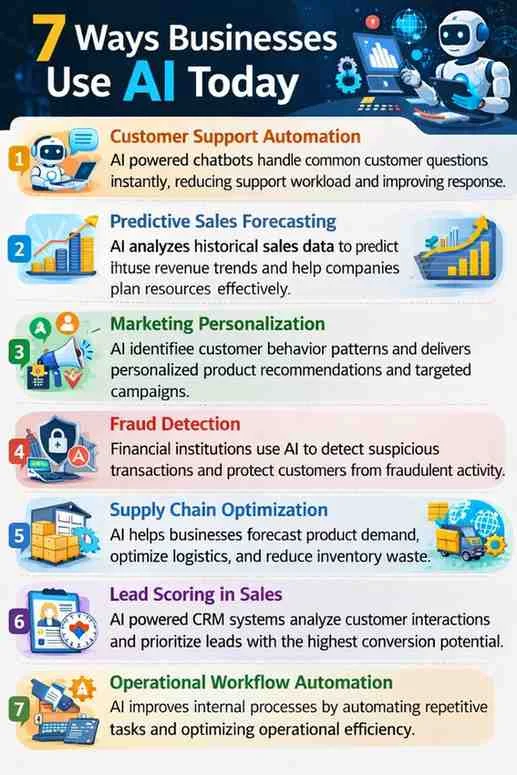
Customer service systems answer thousands of questions automatically.
Sales teams use predictive models to identify high value prospects.
Marketing departments personalize campaigns using behavioral data.
Behind the scenes, companies are using machine learning to forecast demand, detect fraud, optimize logistics, and analyze market trends.
The conversation has shifted.
Businesses are no longer asking:
Should we use AI?
They are asking:
Where can AI create the most impact?
Understanding how artificial intelligence works inside real organizations is essential for any company planning to stay competitive in the coming decade.
What AI in Business Actually Means
Artificial intelligence in business does not mean replacing employees with machines.
In most organizations, AI works as an intelligence layer added to existing systems.
Companies already rely on tools such as CRM platforms, marketing automation software, financial systems, and analytics dashboards.
AI enhances these systems by helping them analyze large amounts of data and detect patterns that humans might miss.
Instead of manually reviewing spreadsheets or reports, AI models process thousands of data points and generate insights in seconds.
This allows businesses to:
Improve decision making
Identify opportunities faster
Predict customer behavior
Optimize operational workflows
For example, a retail company may use AI to analyze customer purchase history and predict which products will sell best during the next season.
A logistics company might use predictive models to optimize delivery routes and reduce fuel costs.
In these scenarios, AI does not replace the team managing operations.
It simply provides better information for making decisions.
From Automation to Intelligent Systems
Many companies already use automation tools.
These tools perform tasks based on predefined rules.
If a customer submits a form, the system sends a confirmation email.
If inventory drops below a certain level, the system automatically reorders products.
Automation improves efficiency, but it cannot adapt or learn.
Artificial intelligence introduces a new capability.
Instead of following fixed instructions, AI systems analyze historical data and continuously improve their predictions.
A machine learning model can examine previous sales data to identify which types of customers are most likely to purchase.
A marketing platform can study campaign performance and automatically adjust targeting strategies.
Customer support systems can analyze message patterns and recommend solutions before an agent responds.
This shift transforms software from a simple task executor into a decision support system.
Automation handles repetitive actions.
AI helps businesses make smarter decisions.
Why Businesses Are Rapidly Adopting AI
Several forces are accelerating AI adoption across industries.
The first factor is data growth.
Every company now generates large amounts of data through websites, mobile applications, transactions, and customer interactions.
Without intelligent systems, much of this data remains unused.
Artificial intelligence converts raw data into insights that guide strategy and operations.
The second factor is competitive pressure.
When one company begins using predictive analytics or automated customer support, competitors quickly notice improvements in efficiency and response times.
AI becomes not just a technological advantage but a business necessity.
The third factor is scalability.
As organizations grow, manual processes become harder to manage.
Customer inquiries increase. Data volumes expand. Operational complexity grows.
AI systems allow companies to handle this growth without dramatically increasing staffing costs.
This is why artificial intelligence has moved from a research concept to a core component of modern business infrastructure.
Where AI Is Used Inside Modern Businesses
Artificial intelligence rarely appears as a single system inside a company.
Instead, it spreads across different departments, improving specific workflows and decision processes.
Most organizations adopt AI gradually. They begin with one department where data already exists and processes are repetitive. Once the results become clear, the technology expands into other areas of the business.
Today, AI is commonly used across marketing, sales, customer support, operations, and financial analysis.
Each department uses AI in slightly different ways, but the underlying goal remains the same.
Improve efficiency, reduce manual work, and make better decisions using data.
Below are the areas where artificial intelligence is having the biggest operational impact.
AI in Marketing and Customer Personalization
Marketing has become one of the fastest areas of AI adoption.
Modern businesses collect large amounts of customer data through websites, email campaigns, social media interactions, and purchase histories.
Analyzing this data manually is almost impossible.
Artificial intelligence systems can process these datasets and identify patterns that reveal customer behavior and preferences.
This allows businesses to personalize marketing efforts at scale.
For example, an online store can recommend products based on previous purchases and browsing activity.
Email marketing platforms can automatically send different messages depending on how customers interact with a brand.
Advertising systems can identify audiences most likely to convert and adjust campaigns accordingly.
The goal of AI in marketing is not simply automation.
It is relevance.
When businesses show the right product or message to the right customer at the right time, marketing becomes far more effective.
AI in Sales Forecasting and Lead Scoring
Sales teams often deal with hundreds or thousands of potential customers.
Not every lead has the same likelihood of converting into revenue.
Artificial intelligence helps sales teams identify which opportunities deserve the most attention.
Many CRM systems now use machine learning to analyze past sales data and customer interactions.
These models evaluate patterns such as:
customer engagement
purchase behavior
communication frequency
deal history
Using this information, the system can assign a probability score to each lead.
This process is known as predictive lead scoring.
Sales representatives can focus their time on the prospects most likely to convert, increasing overall efficiency and closing rates.
AI also improves sales forecasting.
By analyzing historical data, pipeline activity, and seasonal trends, predictive models estimate future revenue more accurately.
Better forecasting allows companies to plan hiring, inventory, and marketing budgets with greater confidence.
AI in Customer Support and Service Automation
Customer support is another area where artificial intelligence has already transformed business operations.
Many companies now use AI powered chatbots to handle routine customer inquiries.
These systems can answer questions about order status, account details, product information, or basic troubleshooting.
Instead of waiting for a human agent, customers receive immediate responses.
This reduces ticket volume and allows support teams to focus on more complex issues.
Advanced customer support platforms go even further.
Artificial intelligence can analyze incoming messages, detect urgency or sentiment, and automatically route requests to the correct department.
Some systems also provide response suggestions to support agents, helping them solve problems faster.
The result is improved response times, reduced operational costs, and more consistent customer experiences.
AI in Operations and Workflow Optimization
Operational efficiency is one of the most powerful benefits of artificial intelligence.
Businesses rely on complex processes involving logistics, scheduling, supply chains, and resource planning.
These systems generate large amounts of operational data.
Artificial intelligence can analyze this data to identify inefficiencies and predict future outcomes.
Manufacturing companies use predictive maintenance models to detect potential equipment failures before they occur.
Logistics companies analyze traffic patterns and demand data to optimize delivery routes.
Retail businesses forecast product demand to manage inventory more effectively.
Even small improvements in operational efficiency can create significant financial benefits when applied across an entire organization.
AI in Finance and Risk Detection
Financial departments depend heavily on accurate analysis and risk detection.
Artificial intelligence helps financial teams process large volumes of transactional data and identify unusual patterns.
Banks have used machine learning models for years to detect fraudulent transactions.
These systems analyze spending behavior and flag suspicious activity in real time.
Businesses also use predictive analytics to forecast cash flow, detect accounting anomalies, and evaluate financial risk.
Because AI systems can monitor thousands of transactions simultaneously, they provide an additional layer of security and financial insight.
For organizations handling large amounts of financial data, this capability is extremely valuable.
Real Examples of AI Applications in Business
Understanding AI in theory is helpful, but the real value becomes clear when we look at how companies are actually using it.
Across industries, businesses are integrating artificial intelligence into specific processes where data analysis and decision making play a major role. Instead of applying AI everywhere, successful organizations focus on areas where intelligent systems can create measurable improvements.
Below are several real business applications where AI is already delivering practical results.
Predictive Analytics for Demand Forecasting
One of the most powerful uses of artificial intelligence in business is demand forecasting.
Retailers, manufacturers, and logistics companies must constantly predict how much product customers will need in the future. If forecasts are inaccurate, companies either run out of inventory or hold excess stock that increases costs.
AI models analyze historical sales data, seasonal patterns, market trends, and customer behavior to forecast demand more accurately.
For example, large retailers use predictive analytics to determine which products will sell during specific seasons. This allows them to prepare inventory levels before demand increases.
Better forecasting helps businesses reduce waste, avoid stock shortages, and improve supply chain planning.
AI Chatbots and Customer Support Automation
Customer support is another area where artificial intelligence is widely used.
AI chatbots can answer common customer questions instantly, reducing the number of requests that reach human support teams.
Typical chatbot tasks include:
• answering frequently asked questions
• checking order status
• guiding users through troubleshooting steps
• directing customers to the correct department
These systems work around the clock and respond immediately, improving customer experience while lowering support costs.
More advanced support platforms combine AI automation with human agents. The system handles routine requests while forwarding complex issues to a support representative.
This hybrid model allows companies to scale customer service without dramatically increasing staff.
AI Driven Marketing Campaign Optimization
Marketing teams increasingly rely on artificial intelligence to analyze campaign performance and improve targeting strategies.
Modern marketing platforms track large amounts of behavioral data such as:
website visits
email engagement
advertising interactions
purchase history
AI systems analyze this data to identify patterns that reveal what types of customers respond best to specific messages.
For example, an AI system may detect that certain customer segments are more likely to respond to email promotions, while others prefer social media advertisements.
Using this information, businesses can automatically adjust campaign targeting, budget allocation, and messaging strategies.
The result is more efficient marketing spending and higher conversion rates.
Fraud Detection and Financial Monitoring
Artificial intelligence has become a critical tool for fraud detection in financial systems.
Banks, payment processors, and e-commerce platforms process millions of transactions every day. Monitoring these transactions manually would be impossible.
AI models analyze spending patterns, transaction histories, and behavioral signals to identify suspicious activity.
When a transaction appears unusual compared to normal behavior, the system can immediately flag it for review or temporarily block it.
This real-time monitoring helps protect both businesses and customers from financial fraud.
In addition to fraud detection, AI systems also assist financial teams with risk analysis and forecasting.
By analyzing large financial datasets, businesses can identify trends that help guide budgeting and investment decisions.
Supply Chain Optimization
Supply chains involve complex networks of suppliers, transportation systems, inventory management, and demand planning.
Artificial intelligence helps companies optimize these systems by analyzing large datasets related to logistics and product movement.
For example, AI can analyze delivery routes, traffic patterns, fuel costs, and shipment schedules to determine the most efficient transportation strategies.
Manufacturers also use predictive models to monitor equipment performance and anticipate maintenance needs before failures occur.
This approach, known as predictive maintenance, helps prevent production delays and reduces operational downtime.
As supply chains become more complex and global, AI driven optimization is becoming an essential capability for many organizations.
Industries Using AI the Most
Artificial intelligence is not limited to technology companies.
In fact, some of the most significant AI adoption is happening in traditional industries that rely heavily on data, logistics, and operational efficiency.
Organizations in sectors such as retail, finance, healthcare, manufacturing, and logistics are using AI to improve forecasting, automate workflows, and enhance customer experiences.
Each industry applies artificial intelligence differently depending on its operational needs.
Understanding these industry level applications helps businesses identify where AI might create the most value.
AI in Retail
Retail companies operate in an environment where customer preferences change quickly and inventory decisions must be accurate.
Artificial intelligence helps retailers analyze customer purchasing behavior, seasonal demand patterns, and market trends.
Online retailers often use recommendation systems that suggest products based on browsing history and previous purchases.
These recommendation engines increase the likelihood that customers will discover products they want to buy.
Retailers also use AI for inventory forecasting. Predictive models estimate how much stock will be needed in the coming weeks or months.
This helps companies avoid both product shortages and excess inventory.
In highly competitive retail markets, even small improvements in demand forecasting and personalization can significantly increase revenue.
AI in Healthcare Business Operations
While artificial intelligence is often associated with medical research and diagnostics, it also plays an important role in healthcare operations.
Hospitals and healthcare providers manage large systems involving patient scheduling, administrative workflows, and resource allocation.
AI systems help healthcare organizations optimize these processes.
For example, predictive models can estimate patient admission rates, allowing hospitals to allocate staff and resources more effectively.
AI is also used to analyze insurance claims, detect billing irregularities, and streamline administrative tasks.
These operational improvements help healthcare organizations reduce costs and improve efficiency while maintaining quality patient care.
AI in Finance and Banking
The financial industry was one of the earliest adopters of artificial intelligence.
Banks, investment firms, and payment platforms process enormous volumes of transactional data every day.
AI systems analyze this data to detect fraud, monitor financial risk, and identify suspicious activity.
Machine learning models are particularly effective at recognizing patterns that indicate fraudulent transactions.
Financial institutions also use AI for credit risk analysis and investment forecasting.
By analyzing historical financial data and economic indicators, predictive models can help institutions assess lending risks and market trends.
Because accuracy and risk management are critical in finance, artificial intelligence has become a core component of modern financial systems.
AI in Manufacturing
Manufacturing companies rely heavily on operational efficiency.
Production delays, equipment failures, or supply chain disruptions can quickly become expensive problems.
Artificial intelligence helps manufacturers monitor production processes and detect potential issues before they occur.
Predictive maintenance systems analyze machine sensor data to identify patterns that indicate upcoming equipment failures.
Instead of waiting for a breakdown, companies can schedule maintenance before production is interrupted.
Manufacturers also use AI to optimize production planning, manage inventory levels, and improve quality control through automated inspection systems.
These improvements allow factories to operate more efficiently while reducing operational risk.
AI in Logistics and Supply Chain Management
Logistics companies manage complex transportation networks involving warehouses, shipping routes, delivery schedules, and fuel costs.
Artificial intelligence helps optimize these systems by analyzing data from multiple sources.
For example, AI models can evaluate traffic patterns, weather conditions, delivery priorities, and transportation costs to determine the most efficient shipping routes.
Large logistics companies use these systems to improve delivery times while reducing fuel consumption and operational costs.
AI also supports warehouse automation by helping companies manage inventory movement, storage efficiency, and order fulfillment processes.
As global supply chains grow more complex, intelligent logistics systems are becoming increasingly important.
Benefits of AI in Business Operations
Artificial intelligence is not adopted simply because it is a new technology. Businesses invest in AI because it produces measurable improvements in efficiency, productivity, and decision making.
When implemented correctly, AI becomes a powerful operational advantage that helps companies scale faster and operate more intelligently.
Below are the major benefits organizations experience when integrating AI into business systems.
Improved Operational Efficiency
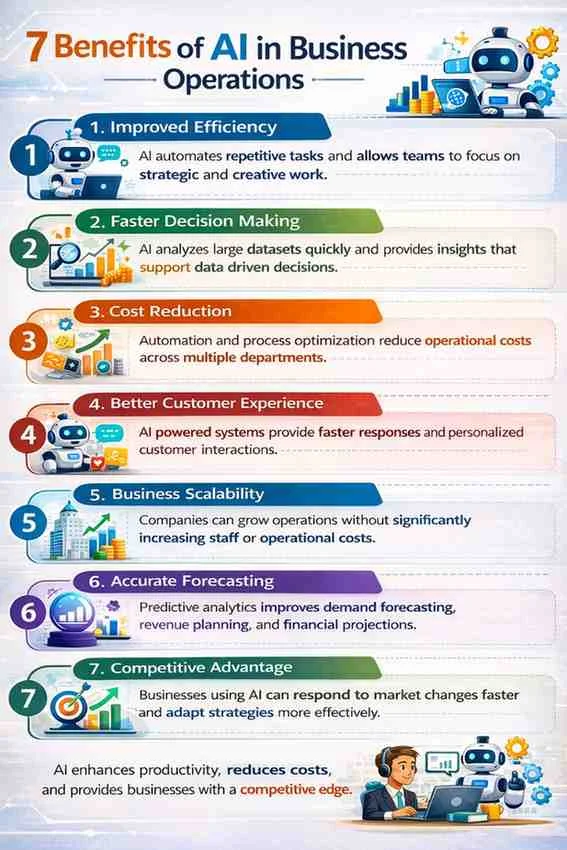
One of the most immediate benefits of AI in business is improved efficiency.
Many business processes involve repetitive tasks such as data analysis, report generation, scheduling, and customer communication.
AI systems can automate or assist with these tasks, allowing employees to focus on higher value activities.
For example, customer support automation can handle thousands of basic inquiries without requiring human intervention. Marketing platforms can analyze campaign data automatically and recommend improvements.
These improvements reduce time spent on manual work and increase overall productivity.
Cost Reduction
Operational efficiency naturally leads to cost savings.
When repetitive tasks are automated and processes become more optimized, companies require fewer resources to manage the same workload.
AI driven demand forecasting can reduce inventory waste. Automated customer support systems lower service costs. Predictive maintenance reduces expensive equipment failures.
These savings can accumulate quickly across multiple departments.
For businesses operating at scale, even small efficiency improvements can translate into significant financial benefits.
Better Decision Making
Businesses generate enormous volumes of data through transactions, customer interactions, and operational processes.
Analyzing this information manually is often slow and incomplete.
Artificial intelligence systems can analyze large datasets quickly and identify patterns that humans might overlook.
Predictive models help companies forecast demand, evaluate risk, and understand customer behavior.
By providing data driven insights, AI helps decision makers act with greater confidence and accuracy.
Scalability
As businesses grow, operational complexity increases.
More customers generate more support requests. More transactions produce more financial data. Larger operations require more planning and coordination.
Artificial intelligence allows companies to scale operations without increasing staff at the same rate.
Automated systems can process larger workloads while maintaining consistent performance.
This scalability is one of the key reasons why many fast growing companies invest heavily in AI technologies.
Enhanced Customer Experience
Customer expectations have changed significantly in recent years.
People expect fast responses, personalized recommendations, and seamless digital experiences.
AI systems help businesses meet these expectations by analyzing customer behavior and tailoring interactions accordingly.
Personalized product recommendations, automated support systems, and intelligent search functions all improve the customer experience.
When customers receive faster service and more relevant offers, satisfaction and loyalty increase.
Challenges and Limitations of AI in Business
Although artificial intelligence offers many advantages, implementing AI is not always straightforward.
Businesses must carefully evaluate the challenges and risks associated with adopting new technologies.
Understanding these limitations helps organizations make more informed decisions when planning AI initiatives.
Data Quality Requirements
Artificial intelligence systems rely heavily on data.
If the underlying data is incomplete, inaccurate, or poorly organized, the results generated by AI models will also be unreliable.
Companies must invest in proper data management and infrastructure before AI can produce meaningful insights.
Without high quality data, even advanced AI systems cannot perform effectively.
Integration Complexity
Many businesses already rely on multiple software systems such as CRM platforms, financial tools, analytics dashboards, and operational software.
Integrating AI solutions into this existing technology ecosystem can be complex.
Systems must communicate with each other, data must flow properly, and processes must be redesigned to incorporate AI insights.
For some organizations, integration challenges become one of the biggest obstacles to successful AI adoption.
AI Bias and Decision Risks
Artificial intelligence models learn from historical data.
If that data contains bias or incomplete patterns, the AI system may produce biased results.
For example, a hiring algorithm trained on biased historical data could unintentionally favor certain candidates over others.
Businesses must carefully monitor AI systems and evaluate outputs to ensure fair and responsible decision making.
Responsible AI governance is becoming an important topic for organizations implementing artificial intelligence.
Privacy and Compliance Concerns
Many AI systems process sensitive information such as customer data, financial records, or behavioral analytics.
Businesses must ensure that AI technologies comply with data privacy regulations and security standards.
Organizations should establish clear policies regarding data usage, storage, and protection.
Maintaining customer trust is essential when implementing data driven technologies.
How Businesses Decide Where to Use AI First
One of the most common mistakes companies make is trying to implement artificial intelligence everywhere at once.
Successful AI adoption usually begins with a focused approach.
Businesses start by identifying processes where AI can deliver the highest impact.
These processes typically share several characteristics.
They involve repetitive tasks, large amounts of data, and decisions that benefit from predictive analysis.
For example, customer support automation, marketing analytics, and demand forecasting are often among the first areas where AI is introduced.
Organizations also evaluate whether the necessary data infrastructure already exists.
Without accessible and structured data, implementing AI can be difficult.
By starting with targeted use cases and expanding gradually, companies can build experience with AI technologies while minimizing risk.
The Future of AI in Business
Artificial intelligence will continue to play a growing role in how companies operate.
As machine learning models improve and computing infrastructure becomes more powerful, businesses will gain access to increasingly advanced capabilities.
Future AI systems will assist with strategic decision making, automate complex workflows, and integrate deeply with business software platforms.
Rather than operating as standalone tools, AI will become embedded across entire digital ecosystems.
Human professionals will still guide strategy, creativity, and leadership, but intelligent systems will support them with faster analysis and predictive insights.
Organizations that learn how to integrate AI responsibly will gain significant advantages in efficiency, innovation, and competitiveness.
Key Takeaways
Artificial intelligence is transforming how modern businesses operate.
Instead of replacing human expertise, AI enhances existing systems by analyzing data, identifying patterns, and supporting better decision making.
Companies across industries are already using AI to improve marketing performance, optimize operations, forecast demand, and enhance customer service.
However, successful AI adoption requires careful planning, reliable data infrastructure, and responsible implementation.
Businesses that focus on practical use cases and measurable outcomes will benefit the most from artificial intelligence technologies.
Frequently Asked Questions About AI in Business
What is AI in business?
AI in business refers to the use of artificial intelligence technologies such as machine learning, predictive analytics, and automation systems to improve business operations and decision making. Companies use AI to analyze data, automate repetitive tasks, forecast trends, and enhance customer experiences.
How are businesses using AI today?
Businesses use AI in many areas including marketing, customer support, sales forecasting, financial analysis, and supply chain management. For example, companies use AI to recommend products, automate support responses, detect fraud, and predict future demand.
What are common examples of AI in business?
Common examples of AI in business include customer service chatbots, predictive sales analytics, personalized marketing recommendations, fraud detection systems, and demand forecasting tools used in retail and logistics.
Can small businesses use AI?
Yes. Many AI tools are now designed specifically for small businesses. Cloud based AI services allow smaller companies to automate marketing, analyze customer data, improve support systems, and manage operations without needing large technical teams.
What are the main benefits of AI for businesses?
AI helps businesses improve efficiency, reduce operational costs, analyze large datasets quickly, and make more accurate decisions. It also enables companies to scale operations while maintaining consistent performance.
Is AI expensive for businesses to implement?
The cost of AI implementation varies depending on the complexity of the system. Many companies start with affordable AI tools integrated into existing platforms such as CRM systems, marketing automation software, or analytics platforms.
What challenges do businesses face when adopting AI?
Common challenges include poor data quality, integration difficulties with existing software systems, lack of technical expertise, and concerns about privacy or regulatory compliance.
Which industries use AI the most?
Industries with large amounts of data tend to use AI the most. These include finance, retail, healthcare, logistics, manufacturing, and digital marketing.
How does AI improve decision making in business?
AI analyzes large datasets and identifies patterns that help organizations predict outcomes and evaluate risks. This allows decision makers to rely on data driven insights rather than assumptions.
What is the future of AI in business?
AI will increasingly become part of everyday business infrastructure. Future systems will assist with strategic planning, automate complex workflows, and provide predictive insights that help companies operate more efficiently.
Refrence: Wikipedia, Google Scholar