

A decade ago, artificial intelligence jobs were rare.
They were mostly found in research labs, tech giants, or advanced academic environments.
Today, AI jobs are everywhere.
Startups are hiring machine learning engineers.
Banks are recruiting AI risk analysts.
Healthcare systems are building predictive models.
Retail companies are hiring data scientists.
Even traditional industries are integrating AI-driven automation.
The shift is not temporary.
Artificial intelligence has moved from experimental technology to business infrastructure.
And whenever a technology becomes infrastructure, jobs follow.
The demand for AI professionals is growing across industries — not just in Silicon Valley, but globally.
But here’s the challenge:
Most people searching for “AI jobs” don’t know where to start.
They don’t know:
- Which roles exist
- Which AI skills matter
- What salaries look like
- Whether certifications are worth it
- How competitive the AI job market really is
What Are AI Jobs? (And How They Differ From Traditional Tech Roles)
When people hear “AI jobs,” they often imagine a single role:
Someone coding complex algorithms in a dark room full of screens.
But artificial intelligence careers are not one job.
They’re an ecosystem.
At its core, an AI job is any role that involves building, deploying, managing, researching, or governing artificial intelligence systems.
That includes:
- Designing machine learning models
- Training neural networks
- Managing AI-powered products
- Working with big data pipelines
- Overseeing AI ethics and compliance
- Integrating automation into business systems
Unlike traditional software engineering, AI roles revolve around data-driven learning systems.
A traditional developer writes logic.
An AI engineer trains models.
A traditional system follows rules.
A machine learning system discovers patterns.
That difference changes everything.
AI Jobs Sit at the Intersection of Multiple Fields
Artificial intelligence careers combine several disciplines:
- Machine learning
- Deep learning
- Data science
- Statistics
- Cloud computing
- Big data infrastructure
- Software engineering
- Automation systems
This is why AI job descriptions often include tools like:
- Python
- TensorFlow
- PyTorch
- SQL
- Cloud platforms
- Data visualization frameworks
It’s not just coding.
It’s understanding how data flows, how models learn, and how predictions turn into decisions.
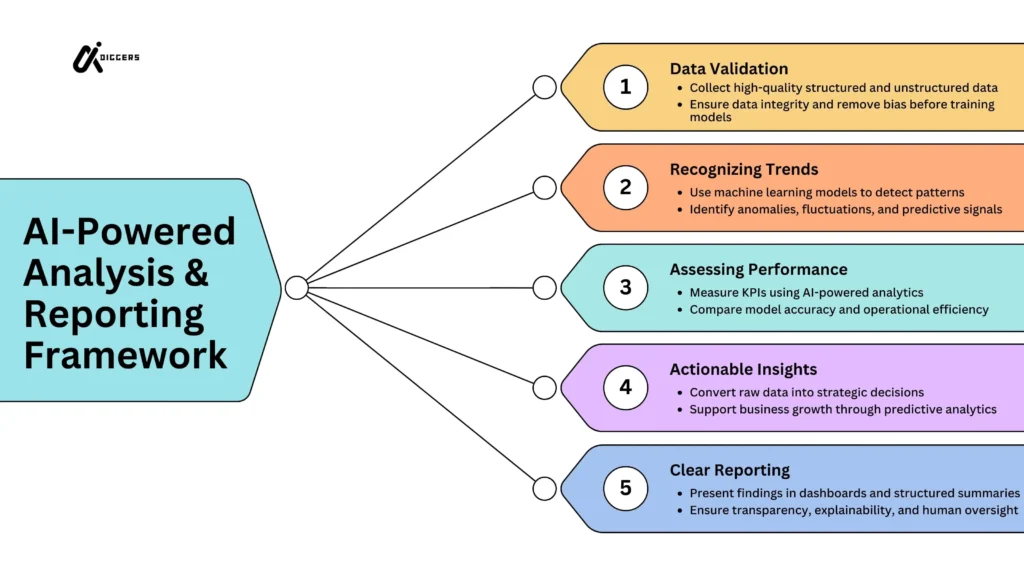
AI Jobs Are Expanding Beyond Engineering
Here’s something many beginners don’t realize:
Not every AI career requires advanced math or a PhD.
Yes, there are AI researchers working on neural networks and large-scale deep learning architectures.
But there are also:
- AI product managers
- AI ethics specialists
- Prompt engineers
- AI business analysts
- AI implementation consultants
- Automation architects
As artificial intelligence adoption increases across industries, companies need professionals who can bridge technical capability and real-world application.
The AI job market is expanding horizontally — not just vertically.
That’s why understanding career paths in artificial intelligence matters more than just chasing a title.
The Most In-Demand AI Job Roles in 2026
AI jobs are not interchangeable.
Each role operates at a different layer of artificial intelligence systems — from model research to deployment to governance.
Let’s break down the top AI careers in detail.
1️⃣ Machine Learning Engineer
Machine learning engineers design and deploy predictive models that power AI-driven systems.
They work heavily with neural networks, deep learning frameworks, and scalable cloud infrastructure.
Role Overview
| Category | Details |
| Primary Focus | Building and deploying machine learning models |
| Core Responsibilities | Model training, feature engineering, performance tuning, production deployment |
| Required Skills | Python, statistics, deep learning, data preprocessing |
| Tools & Frameworks | TensorFlow, PyTorch, Scikit-learn, SQL, cloud platforms |
| Education | Computer Science, Data Science, or related field |
| Average US Salary (2026 est.) | $130,000 – $180,000 |
| Career Path | Senior ML Engineer → AI Architect → AI Lead |
Machine learning engineer salary remains among the highest in AI careers because these professionals sit at the core of AI infrastructure.
2️⃣ AI Engineer
AI engineers integrate machine learning systems into real-world applications.
They ensure models function reliably in production environments.
Role Overview
| Category | Details |
| Primary Focus | Deploying and maintaining AI-powered systems |
| Core Responsibilities | API integration, model deployment, automation workflows |
| Required Skills | Python, cloud computing, DevOps basics, model optimization |
| Tools & Frameworks | AWS, Azure, Docker, Kubernetes, TensorFlow |
| Education | Computer Science or Engineering |
| Average US Salary (2026 est.) | $125,000 – $170,000 |
| Career Path | Senior AI Engineer → AI Systems Architect |
AI engineer jobs are growing rapidly as companies move from experimentation to implementation.
3️⃣ Data Scientist
Data scientists analyze large datasets and extract insights that feed machine learning systems.
They often act as the analytical foundation of AI projects.
Role Overview
| Category | Details |
| Primary Focus | Data analysis and predictive modeling |
| Core Responsibilities | Data cleaning, visualization, statistical modeling |
| Required Skills | Python, R, SQL, statistics, machine learning basics |
| Tools & Frameworks | Pandas, NumPy, Tableau, Scikit-learn |
| Education | Data Science, Statistics, Computer Science |
| Average US Salary (2026 est.) | $110,000 – $160,000 |
| Career Path | Senior Data Scientist → ML Engineer → AI Specialist |
Data scientist salary remains competitive due to continued big data demand.
4️⃣ NLP Engineer (Natural Language Processing Specialist)
NLP engineers focus on AI systems that understand and generate human language.
With generative AI adoption expanding, demand for NLP specialists is rising.
Role Overview
| Category | Details |
| Primary Focus | Language models and text-based AI systems |
| Core Responsibilities | Text classification, chatbot systems, model fine-tuning |
| Required Skills | Python, NLP techniques, deep learning, linguistics basics |
| Tools & Frameworks | Transformers, Hugging Face, PyTorch, spaCy |
| Education | AI, Computer Science, Computational Linguistics |
| Average US Salary (2026 est.) | $120,000 – $170,000 |
| Career Path | Senior NLP Engineer → AI Research Lead |
5️⃣ Prompt Engineer
Prompt engineering focuses on optimizing inputs for generative AI models.
This role bridges AI systems and user experience.
Role Overview
| Category | Details |
| Primary Focus | Optimizing AI-generated outputs |
| Core Responsibilities | Designing prompts, workflow testing, output evaluation |
| Required Skills | AI model understanding, communication, system thinking |
| Tools & Frameworks | Large language models, generative AI platforms |
| Education | Flexible — technical background helpful |
| Average US Salary (2026 est.) | $90,000 – $150,000 |
| Career Path | AI Strategy Consultant → AI Product Lead |
This role reflects how AI applications are expanding beyond pure engineering.
6️⃣ AI Product Manager
AI product managers guide AI feature strategy within companies.
They balance technical feasibility with business goals.
Role Overview
| Category | Details |
| Primary Focus | AI feature development and product integration |
| Core Responsibilities | Roadmapping, stakeholder coordination, AI strategy |
| Required Skills | AI fundamentals, product management, data literacy |
| Tools & Frameworks | Analytics platforms, cloud AI tools |
| Education | Business + Technical hybrid |
| Average US Salary (2026 est.) | $130,000 – $175,000 |
| Career Path | Head of AI Product → Director of AI Strategy |
7️⃣ AI Researcher
AI researchers work on advancing artificial intelligence itself.
They focus on deep learning models, neural networks, and innovation.
Role Overview
| Category | Details |
| Primary Focus | Developing new AI algorithms and architectures |
| Core Responsibilities | Research, experimentation, publishing, optimization |
| Required Skills | Advanced math, deep learning, neural networks |
| Tools & Frameworks | PyTorch, TensorFlow, research toolkits |
| Education | Master’s or PhD often required |
| Average US Salary (2026 est.) | $140,000 – $200,000+ |
| Career Path | Senior Research Scientist → AI Lab Director |
8️⃣ AI Ethics Specialist
As AI adoption expands, ethical oversight becomes critical.
Role Overview
| Category | Details |
| Primary Focus | Responsible AI governance |
| Core Responsibilities | Bias audits, compliance monitoring, fairness testing |
| Required Skills | Policy knowledge, AI literacy, risk assessment |
| Tools & Frameworks | AI audit tools, governance platforms |
| Education | Ethics, Law, Computer Science |
| Average US Salary (2026 est.) | $100,000 – $160,000 |
| Career Path | AI Governance Lead → Chief AI Ethics Officer |
Highest Paying AI Jobs in 2026 (Based on Current Market Trends)
AI salaries vary based on:
- Experience level
- Location (US vs global)
- Industry (tech vs healthcare vs finance)
- Company size
- Research vs applied roles
Below are realistic US-based salary ranges compiled from current industry benchmarks (Glassdoor, Levels.fyi, BLS, Indeed data trends).
Top AI Roles by Average Salary (US Market)
| Role | Entry-Level | Mid-Level | Senior-Level |
| AI Research Scientist | $120k–$150k | $150k–$180k | $180k–$220k+ |
| Machine Learning Engineer | $110k–$135k | $135k–$165k | $165k–$190k |
| AI Engineer | $105k–$130k | $130k–$160k | $160k–$185k |
| NLP Engineer | $110k–$140k | $140k–$165k | $165k–$190k |
| Data Scientist | $95k–$120k | $120k–$145k | $145k–$170k |
| AI Product Manager | $115k–$145k | $145k–$170k | $170k–$200k |
| AI Ethics Specialist | $90k–$115k | $115k–$140k | $140k–$165k |
These numbers reflect US averages in strong AI hiring markets such as California, Texas, New York, and Washington.
Compensation in major tech companies can exceed these ranges due to equity packages.
Why AI Jobs Pay More Than Traditional Tech Roles
AI roles often command higher salaries because they require:
- Advanced math and statistics knowledge
- Experience with neural networks and deep learning
- Strong Python and machine learning framework skills
- Big data processing expertise
- Cloud infrastructure knowledge
The barrier to entry is higher.
The talent supply is smaller.
The demand is growing.
That combination drives salary levels upward.
Highest Paying AI Jobs (Ranked by Senior-Level Compensation)
- AI Research Scientist
- AI Product Manager (in large tech firms)
- Senior Machine Learning Engineer
- Senior NLP Engineer
- AI Systems Architect
Research-focused roles tend to pay the most at top-tier tech companies and AI research labs.
However, machine learning engineering roles often offer stronger long-term career scalability because they combine research and production expertise.
Important Reality Check
Not all AI jobs start at six figures.
Entry-level roles in smaller markets may start closer to:
- $85k–$105k for junior data roles
- $95k–$115k for junior ML positions
Your salary depends heavily on:
- Skills (Python, TensorFlow, PyTorch, deep learning experience)
- Portfolio projects
- Internships
- Location
- Industry adoption level
AI salary 2026 projections show steady growth — but not unrealistic spikes.
The field is strong, but competitive.
AI Skills Required to Get These Jobs
Here’s the truth most beginners don’t hear:
AI jobs don’t require you to know everything.
But they do require you to know the right things deeply.
Artificial intelligence careers sit at the intersection of programming, mathematics, data, and systems thinking.
If you look at job descriptions for machine learning engineer, NLP engineer, or AI engineer roles, certain skills appear repeatedly.
Let’s break them down clearly.
Core Technical Skills for AI Careers
1️⃣ Programming (Python Is Essential)
If you search “AI programming languages,” one language dominates:
Python.
It’s the foundation for:
- Machine learning models
- Deep learning systems
- Neural network training
- Data science workflows
- Automation scripts
Most AI frameworks are built around Python, including:
- TensorFlow
- PyTorch
- Scikit-learn
- Keras
- Hugging Face
Without Python, entering the AI job market becomes significantly harder.
Other useful languages:
| Language | Why It Matters |
| Python | Core AI development language |
| SQL | Managing and querying large datasets |
| R | Statistical modeling (more common in research/data science) |
| Java / C++ | Performance-heavy AI systems |
But if you’re starting — focus on Python first.
2️⃣ Machine Learning & Deep Learning
Understanding how machine learning works is non-negotiable.
You should know:
- Supervised vs unsupervised learning
- Regression vs classification
- Model evaluation metrics
- Overfitting and underfitting
- Feature engineering basics
For deeper roles, you’ll need:
- Neural networks
- Convolutional neural networks (CNNs)
- Recurrent neural networks (RNNs)
- Transformers
- Backpropagation
Deep learning skills are especially important for NLP engineer and AI research roles.
3️⃣ Data Handling & Big Data
AI runs on data.
If you can’t clean, structure, and analyze data — you can’t build reliable AI systems.
Key areas include:
- Data preprocessing
- Pandas & NumPy
- Data visualization
- Big data systems
- Cloud-based data pipelines
Companies value professionals who can move from raw data → trained model → production deployment.
That full pipeline skillset increases job security.
4️⃣ Cloud Computing & Deployment
Modern AI doesn’t live on a laptop.
It lives in the cloud.
Understanding platforms like:
- AWS
- Google Cloud
- Azure
is increasingly important.
Why?
Because AI job roles today often require deploying models into real applications — not just building them in notebooks.
Cloud computing + AI = real-world scalability.
5️⃣ Soft Skills (Underrated but Critical)
Technical strength alone is not enough.
AI professionals must also:
- Communicate complex ideas clearly
- Understand business objectives
- Collaborate across teams
- Think critically about AI ethics
Especially for roles like AI product manager or AI consultant, communication is as important as coding.
AI Skills by Role (Quick Comparison)
| Role | Must-Have Skills |
| Machine Learning Engineer | Python, ML models, TensorFlow/PyTorch, deployment |
| Data Scientist | Python, statistics, data analysis, visualization |
| NLP Engineer | Deep learning, transformers, language models |
| AI Product Manager | AI fundamentals, business strategy, analytics |
| AI Researcher | Advanced math, neural networks, experimentation |
| AI Ethics Specialist | AI governance, bias mitigation, policy knowledge |
The Reality About AI Skill Development
You don’t need:
- 10 certifications
- 5 programming languages
- A PhD (for most roles)
You need:
- Solid Python
- Strong ML fundamentals
- Practical projects
- Understanding of data systems
That combination makes you employable.
Not hype.
Not trends.
Skills.
AI Certifications and Courses — What’s Actually Worth It?
There’s a common mistake beginners make when entering AI careers.
They think more certificates = better chances.
That’s not how hiring works in artificial intelligence.
Employers hiring for AI jobs care about:
- Demonstrated skills
- Real projects
- Understanding of machine learning concepts
- Ability to work with data
- Problem-solving ability
Certifications can help — but only when they build real competence.
Let’s break this down clearly.
When AI Certifications Actually Help
Certifications are useful if they:
- Provide structured learning
- Teach practical implementation
- Include real-world projects
- Cover industry tools like Python, TensorFlow, PyTorch
- Demonstrate cloud deployment knowledge
They are especially helpful for:
- Career switchers
- Non-technical backgrounds
- Entry-level candidates
But certifications alone will not secure high-paying AI roles.
Projects matter more.
Types of AI Certifications Worth Considering
Instead of listing random courses, let’s categorize what’s actually valuable.
| Category | Who It’s For | Why It Matters |
| Machine Learning Specializations | Beginners | Builds ML foundations |
| Deep Learning Courses | Intermediate learners | Required for advanced AI roles |
| Cloud AI Certifications | Job-ready candidates | Demonstrates deployment skills |
| Data Science Certifications | Data-focused roles | Strong statistical foundation |
| AI Ethics Certifications | Governance roles | Growing compliance demand |
Certifications tied to major cloud providers (AWS, Azure, Google Cloud) are particularly respected because AI increasingly integrates with cloud computing.
What Hiring Managers Actually Look For
If someone is applying for a machine learning engineer role, the hiring team usually asks:
- Have you built and deployed a model?
- Can you explain overfitting?
- Do you understand neural networks?
- Have you worked with large datasets?
- Can you write clean Python code?
They rarely ask:
“How many certificates do you have?”
AI certifications are a support tool — not the foundation.
Better Than Certificates: Build Proof
Instead of collecting courses, focus on:
- GitHub projects
- End-to-end ML pipelines
- Kaggle competitions
- Real-world problem-solving
- Documented case studies
In the AI job market, proof beats paper.
Always.
AI Job Market Demand and Growth Trends
If you remove the headlines and look at actual hiring patterns, one thing becomes clear:
AI jobs are no longer limited to tech companies.
Artificial intelligence has moved into finance, healthcare, retail, logistics, manufacturing, cybersecurity, education, and even government sectors.
The demand isn’t driven by hype.
It’s driven by integration.
Companies are embedding machine learning, automation systems, and data-driven decision models into everyday operations. And when AI becomes operational infrastructure, demand for skilled professionals increases steadily — not explosively, but sustainably.
Why AI Job Demand Keeps Growing
There are four main forces driving AI job growth:
1️⃣ Industry Adoption Is Expanding
Businesses are no longer asking:
“Should we use AI?”
They are asking:
“How do we integrate AI efficiently?”
This shift creates demand for:
- Machine learning engineers
- AI engineers
- Data scientists
- AI product managers
- Cloud AI specialists
Adoption is moving from experimentation to implementation.
2️⃣ Data Volume Is Increasing
Every year, global data volume increases.
More data means:
- More machine learning opportunities
- More predictive modeling
- More automation systems
- Greater need for big data infrastructure
AI jobs grow because data keeps growing.
3️⃣ AI Is Becoming a Competitive Advantage
Companies using AI effectively often gain:
- Faster decision-making
- Better customer targeting
- Operational efficiency
- Cost optimization
That competitive pressure pushes other companies to hire AI talent as well.
4️⃣ Skill Supply Is Still Limited
While AI courses are everywhere, true expertise is not.
There’s still a shortage of professionals who can:
- Train deep learning models
- Deploy systems in cloud environments
- Manage neural network optimization
- Design scalable AI architectures
That supply-demand imbalance supports steady AI job market demand.
AI Job Growth Trends (Realistic View)
Artificial intelligence is expected to continue expanding over the next decade, particularly in roles connected to:
- Machine learning engineering
- Data science
- AI system architecture
- AI governance and ethics
- Automation engineering
However, the market is becoming more competitive at the entry level.
Bootcamps and online courses have increased candidate volume.
Which means:
Skill depth matters more than surface-level familiarity.
AI job growth is real — but so is competition.
Where Demand Is Strongest
Currently, strong AI hiring clusters exist in:
- Major US tech hubs
- Remote-first companies
- Cloud-focused enterprises
- Fintech and healthcare sectors
- AI research labs
Remote AI jobs are also increasing, especially in:
- Data science
- AI engineering
- NLP development
- AI consulting
Remote AI Jobs and Global Opportunities
A few years ago, most artificial intelligence jobs were location-bound.
If you wanted to work in AI research or machine learning engineering, you often needed to live near a tech hub.
That’s no longer fully true.
The rise of cloud computing, distributed teams, and AI-first startups has changed the structure of the AI job market.
Many AI roles today can be performed remotely — especially those focused on software, data, and model development.
But not all AI jobs are equally remote-friendly.
Let’s break this down clearly.
AI Roles That Commonly Offer Remote Opportunities
| Role | Remote Potential | Why |
| Machine Learning Engineer | High | Work is code and cloud-based |
| Data Scientist | High | Data analysis can be done remotely |
| NLP Engineer | High | Model training & fine-tuning are remote-friendly |
| AI Product Manager | Medium-High | Depends on company structure |
| AI Researcher | Medium | Some labs require hybrid work |
| AI Robotics Engineer | Low-Medium | Physical hardware often required |
Most AI software-focused roles operate in:
- Cloud environments
- Virtual collaboration systems
- Distributed Git repositories
- Remote DevOps pipelines
This makes them structurally compatible with remote work.
Why Remote AI Jobs Are Increasing
Three major forces are driving this shift:
1️⃣ Cloud Infrastructure
AI systems now run on AWS, Azure, or Google Cloud — not local machines.
2️⃣ Talent Shortage
Companies expand hiring globally to access AI talent.
3️⃣ Cost Optimization
Remote teams reduce operational costs while increasing flexibility.
As a result, AI remote jobs are becoming a meaningful portion of the hiring ecosystem.
Global Opportunities in AI Careers
Artificial intelligence is not limited to the US.
Strong AI job markets are emerging in:
- North America
- Europe
- India
- Canada
- Singapore
- Australia
However, salary expectations vary significantly by region.
US-based AI salaries remain among the highest globally, particularly in:
- Senior machine learning roles
- AI research positions
- AI product leadership
But remote AI jobs allow professionals outside major tech hubs to participate in global projects.
That shift is important.
AI careers are becoming less geographically restricted.
Reality Check About Remote AI Jobs
Remote AI work still requires:
- Strong communication skills
- Self-management
- Technical depth
- Reliable internet and secure systems
And competition can be intense.
Global hiring means you’re competing with candidates worldwide.
Which means your portfolio and demonstrated skill matter even more.
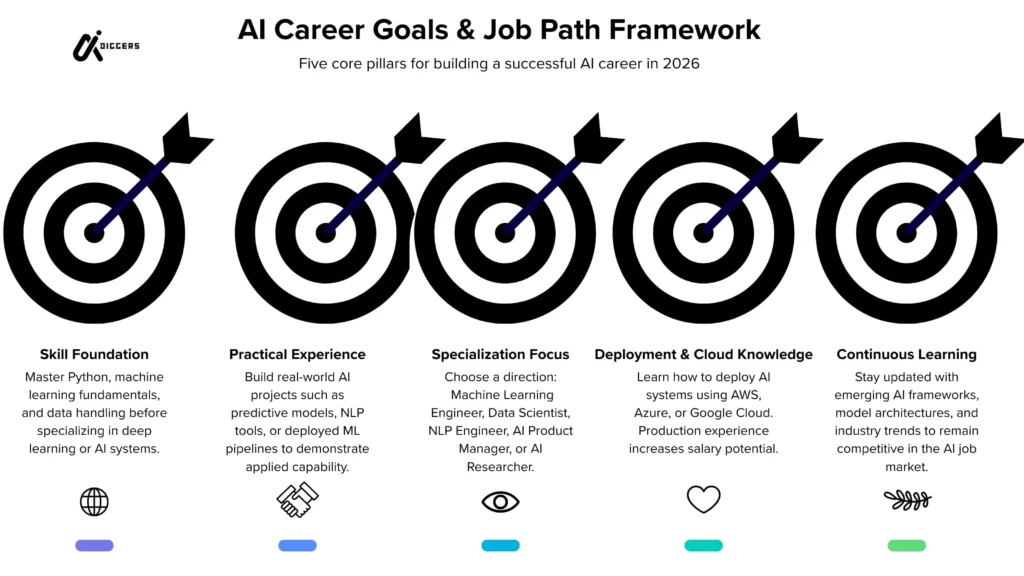
How to Start a Career in AI (Step-by-Step Roadmap)
If you’re searching for “how to get a job in AI” or “how to start a career in artificial intelligence,” you don’t need theory.
You need structure.
The AI career path isn’t random. It’s layered.
Here’s a realistic roadmap that aligns with how companies actually hire.
Step 1: Build a Strong Foundation in Python
Almost every AI job requires Python.
Before touching deep learning or neural networks, you should be comfortable with:
- Variables and functions
- Loops and conditionals
- Data structures
- Writing clean, readable code
Then move into:
- NumPy
- Pandas
- Matplotlib
You cannot build machine learning systems without being comfortable manipulating data.
Python for AI jobs is not optional — it’s foundational.
Step 2: Understand Machine Learning Fundamentals
This is where most beginners rush — and fail.
Before touching advanced frameworks like TensorFlow or PyTorch, you must understand:
- Supervised vs unsupervised learning
- Regression and classification
- Model evaluation metrics
- Bias vs variance
- Overfitting
- Training vs testing data
Without these concepts, you’re just copying code.
Companies don’t hire people who copy tutorials.
They hire people who understand why models behave the way they do.
Step 3: Learn Deep Learning and Neural Networks
Once fundamentals are strong, move into:
- Neural networks
- Backpropagation
- Convolutional neural networks (CNNs)
- Recurrent neural networks (RNNs)
- Transformer models
At this stage, begin using:
- TensorFlow
- PyTorch
Deep learning skills are especially important for roles like:
- Machine learning engineer
- NLP engineer
- AI researcher
But depth matters more than breadth.
Master one framework properly.
Step 4: Build Real Projects (This Is Critical)
This is where most people separate themselves.
Certifications help.
Projects convince.
Examples of strong AI portfolio projects:
- Predictive model using real-world dataset
- NLP sentiment analysis tool
- Image classification system
- End-to-end ML deployment on cloud
- AI-powered dashboard
Employers want proof you can move from:
Raw data → Model → Deployment → Interpretation.
That pipeline understanding is what gets interviews.
Step 5: Learn Cloud Deployment Basics
Modern AI lives in the cloud.
Understanding how to:
- Deploy models using AWS or Azure
- Use Docker containers
- Manage APIs
- Handle production environments
makes you far more employable.
AI engineering is no longer just experimentation — it’s production.
Step 6: Choose a Direction
Not all AI careers are the same.
After foundation building, choose your path:
| Path | Focus |
| Machine Learning Engineer | Model building & deployment |
| Data Scientist | Data analysis & prediction |
| NLP Engineer | Language models |
| AI Product Manager | Strategy & integration |
| AI Researcher | Algorithm innovation |
| AI Ethics Specialist | Governance & fairness |
Clarity reduces overwhelm.
AI learning path for jobs becomes easier when you stop trying to master everything.
Step 7: Apply Strategically
When applying for AI jobs:
- Tailor your resume to the role
- Highlight relevant projects
- Emphasize Python + ML experience
- Demonstrate understanding of neural networks or data pipelines
- Prepare for technical interviews
The AI job market rewards demonstrated competence.
Not buzzwords.
Frequently Asked Questions About AI Jobs
What qualifications do I need for AI jobs?
Most AI jobs require a background in computer science, data science, mathematics, or engineering. However, formal degrees are not always mandatory.
Employers care more about:
Strong Python programming skills
Understanding of machine learning and deep learning
Experience with neural networks or data modeling
Practical portfolio projects
For advanced roles like AI researcher, a Master’s or PhD may be required. But many AI engineering and data roles are accessible through skill-based learning and strong project work.
Which AI job is best for beginners?
For beginners, entry points often include:
Junior Data Scientist
Machine Learning Intern
AI Analyst
Python Developer transitioning into ML
Data-focused roles are often more accessible than deep research positions.
The best beginner AI career path is one that builds strong fundamentals in Python, statistics, and machine learning before specializing.
Is AI a good career in 2026 and beyond?
AI remains one of the strongest long-term career fields due to:
Continued industry adoption
Increasing automation
Growth in cloud computing
Expansion of data-driven decision systems
While competition is increasing, demand for skilled AI professionals remains steady across industries including healthcare, finance, retail, and logistics.
AI careers are not just a trend — they are connected to structural changes in how businesses operate.
What is the highest paying AI job?
Among current roles, the highest paying AI jobs typically include:
AI Research Scientist
Senior Machine Learning Engineer
AI Product Manager (in large tech firms)
AI Systems Architect
Salaries vary by experience, company, and location, but senior-level AI roles in the US commonly exceed six figures.
Compensation increases significantly with production experience and cloud deployment expertise.
Are AI certifications enough to get hired?
No.
Certifications can support learning, but they do not replace:
Real-world projects
GitHub portfolios
Deployment experience
Technical interview readiness
In the AI job market, demonstrated skill outweighs certificates.
Can I get AI remote jobs?
Yes — especially in roles like:
Machine learning engineer
Data scientist
NLP engineer
AI consultant
Remote AI jobs are increasingly common due to cloud-based infrastructure and distributed teams. However, global competition means skill depth is critical.
Final Takeaway: AI Jobs Are Expanding — But Preparation Matters
AI jobs are no longer confined to research labs or elite tech companies.
Artificial intelligence has become embedded in business systems, automation platforms, financial modeling, healthcare diagnostics, and cloud infrastructure.
That expansion creates opportunity.
But opportunity does not remove competition.
The AI job market rewards:
- Strong Python skills
- Deep understanding of machine learning
- Practical deployment knowledge
- Clear specialization
- Real project experience
Artificial intelligence careers are growing — but they favor preparation over shortcuts.
If you approach AI as a structured learning path rather than a trend, you position yourself for long-term growth in one of the most influential industries of this decade.
Refrence: Wikipedia, Google Scholar