

A few years ago, content creation meant one thing.
Humans writing.
Marketers brainstorming.
Bloggers drafting.
Editors revising.
Designers building visuals manually.
Then artificial intelligence entered the creative process.
At first, AI-generated content felt experimental.
Today, AI content creation tools are embedded in blogging platforms, marketing agencies, e-commerce stores, SaaS companies, and even newsroom workflows.
But here’s where confusion begins.
Many people think AI content creation means:
“Press a button → publish content.”
That’s not how professionals use it.
Real AI-powered content creation is not automation replacing creativity.
It’s augmentation enhancing it.
Understanding that difference changes everything.
What Is AI Content Creation?
AI content creation refers to the use of artificial intelligence systems to assist in producing written, visual, audio, or multimedia content.
These systems rely on:
- Machine learning
- Natural language processing (NLP)
- Generative AI models
- Deep learning architectures
AI tools analyze large datasets of text, patterns, and language structures to generate:
- Blog posts
- Social media captions
- Product descriptions
- Email campaigns
- Video scripts
- Marketing copy
- SEO outlines
But AI doesn’t “think.”
It predicts.
It calculates the most probable next word based on training data.
That prediction mechanism is what powers AI writing tools and content automation systems.
Why AI Content Creation Is Growing Rapidly
Three forces are driving growth:
1. Content Demand Is Exploding
Businesses need blog posts, landing pages, newsletters, and social content at scale.
2. SEO Competition Is Increasing
Websites must publish consistent, high-quality content to compete.
3. Workflow Efficiency Matters
AI tools reduce drafting time and speed up ideation.
But speed alone does not create authority.
Strategy does.
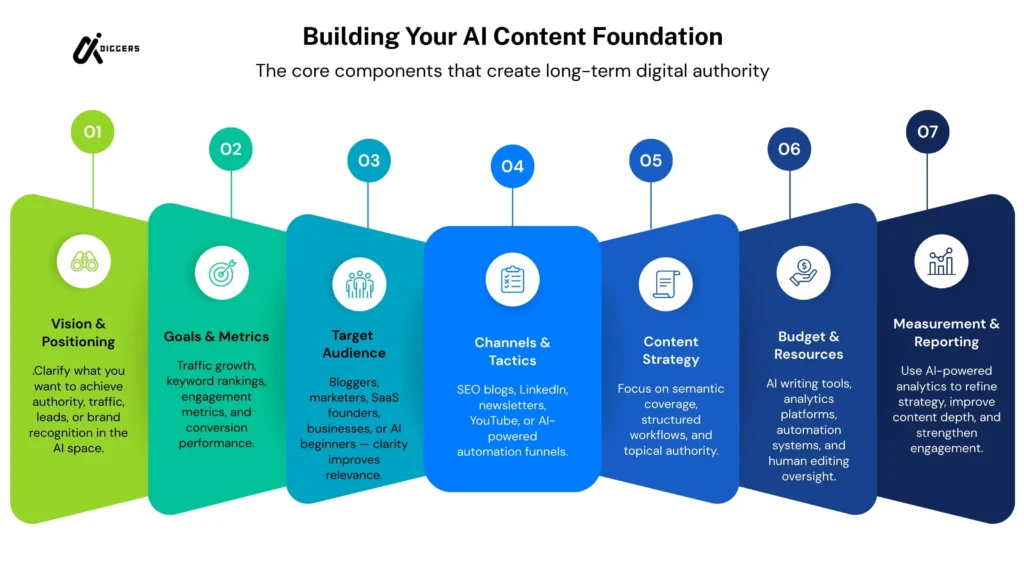
How AI Content Creation Actually Works (Behind the Scenes)
To understand AI content creation properly, you need to move past the interface.
The text box.
The “Generate” button.
The output.
Behind every AI writing tool is a generative model trained on massive amounts of language data.
These systems use a combination of:
- Natural language processing (NLP)
- Deep learning
- Neural networks
- Large language models (LLMs)
Here’s what actually happens when you ask an AI tool to create content.
Step 1: Pattern Recognition at Scale
AI models are trained on enormous datasets containing books, articles, websites, and structured language examples.
They don’t memorize everything.
They learn patterns.
For example:
- How introductions are structured
- How persuasive copy flows
- How blog posts transition between sections
- How questions are answered
- How headlines are written
The model identifies statistical relationships between words and phrases.
That’s why AI-generated content often feels structured and coherent.
It has seen millions of examples.
Step 2: Predictive Text Generation
When you enter a prompt, the model doesn’t “think.”
It calculates.
Word by word.
It predicts the most likely next token based on:
- Context
- Probability
- Language patterns
- Prompt framing
This is why prompt engineering matters.
Clear prompts → structured outputs.
Vague prompts → generic content.
AI writing process quality depends heavily on instruction clarity.
Step 3: Context Windows & Constraints
AI systems operate within something called a context window.
This determines how much text the model can consider at once.
Long-form AI content creation requires careful structuring to avoid:
- Repetition
- Loss of logical flow
- Topic drift
Professional AI content workflows use section-by-section drafting instead of full-article generation.
That’s how you maintain depth and coherence.
Step 4: Human Refinement
This is where serious creators separate themselves.
AI drafts.
Humans refine.
AI can:
- Generate structure
- Suggest ideas
- Accelerate drafting
- Improve formatting
But it cannot:
- Inject lived experience
- Validate real-world claims
- Verify statistics
- Ensure strategic positioning
- Align fully with brand voice
AI-assisted content creation works best when humans remain editors, strategists, and quality controllers.
A Simple Breakdown of the AI Content Process
| Stage | AI Role | Human Role |
| Ideation | Topic suggestions | Strategic selection |
| Outline | Structural drafting | Refinement |
| First Draft | Text generation | Editing & enhancement |
| SEO Optimization | Keyword suggestions | Intent alignment |
| Publishing | Formatting assistance | Final approval |
AI Content Workflow: From Idea to Published Content
Most people use AI tools randomly.
They open a content generator.
Type a vague instruction.
Copy the output.
Publish.
That is not a workflow.
That is automation without strategy.
Professional AI content creation follows a defined process — especially when the goal is SEO, blogging authority, or content marketing growth.
Let’s break down a structured AI content workflow that actually works.
Stage 1: Topic & Intent Research
Before AI writes anything, clarity is required.
Ask:
- What is the primary keyword?
- What is the search intent? (Informational, commercial, transactional)
- Who is the audience?
- What problem is being solved?
AI tools can assist with keyword variations and topic expansion, but humans must define positioning.
For example:
“AI content creation” could target:
- Bloggers
- Marketing agencies
- SaaS companies
- E-commerce brands
The direction changes everything.
Strategy comes first.
Automation comes second.
Stage 2: Structure Before Writing
This is where many creators fail.
Instead of asking AI to “write a full blog post,” professionals:
- Generate a table of contents
- Define section hierarchy (H1, H2, H3)
- Map semantic keywords
- Identify internal linking opportunities
This prevents thin content and improves topical depth.
AI writing process works best when guided by structure.
Stage 3: Section-by-Section Drafting
Instead of generating 2,000 words at once, break it down.
Generate:
- Introduction
- One section at a time
- Supporting tables where helpful
- FAQs separately
This improves:
- Coherence
- Logical progression
- Engagement
- Quality control
AI tools are strong at focused tasks.
They struggle with long unstructured outputs.
Stage 4: Human Editing & Value Injection
This is the most important stage.
Add:
- Real insights
- Clear examples
- Industry context
- Data verification
- Strategic positioning
- Brand tone alignment
Without this stage, AI-generated content often feels generic.
Human refinement transforms AI drafts into authority content.
Stage 5: SEO Optimization & Publishing
Now optimize for:
- Primary keyword placement
- Semantic keyword variations
- Meta title & description
- Internal linking
- FAQ schema
- Readability
AI can assist in identifying keyword density or structure gaps, but human review ensures intent alignment.
AI Content Workflow (Quick Visual Summary)
| Stage | Focus | Risk If Skipped |
| Topic Research | Intent clarity | Misaligned audience |
| Structured Outline | Depth & organization | Thin content |
| Section Drafting | Controlled generation | Repetition |
| Human Editing | Authority & trust | Generic output |
| SEO Optimization | Visibility | Low rankings |
AI for blogging and AI for content marketing work best when embedded inside a defined workflow — not used impulsively.
AI Content Strategy: Why Most People Get It Wrong
Last year, a small marketing agency decided to “go all in” on AI content creation.
They bought the best tools.
Generated 200 articles in two months.
Automated publishing.
Scheduled everything.
Traffic increased slightly.
Then it stalled.
Then it dropped.
Why?
Because they scaled output — not strategy.
AI made publishing easier.
But it didn’t make their content better.
That’s the mistake most creators make.
They treat AI as a volume machine.
But search engines don’t reward volume.
They reward value.
AI Is a Tool — Not a Direction
Imagine giving a Formula 1 car to someone without a map.
Speed alone doesn’t guarantee you reach the right destination.
AI content creation works the same way.
Without strategy, you get:
- Keyword stuffing
- Thin topical coverage
- Repetitive blog posts
- No internal linking architecture
- No authority signals
With strategy, you get:
- Structured pillar pages
- Topical clusters
- Semantic keyword coverage
- Intent alignment
- Content ecosystems
That’s the difference between noise and authority.
The Real AI Content Strategy Shift
Before AI, content marketing was slow.
One blog post per week felt productive.
Now?
You can draft five outlines in an hour.
The bottleneck has shifted.
It’s no longer production.
It’s thinking.
Your competitive advantage in the AI era isn’t writing speed.
It’s strategic clarity.
What Smart Creators Do With AI
They don’t ask:
“Write me a blog post about AI.”
They ask:
“Help me build a structured authority cluster around AI content marketing.”
They use AI to:
- Map internal links
- Expand semantic entities
- Strengthen topical depth
- Analyze content gaps
- Refine structure
They treat AI as an assistant strategist.
Not a ghostwriter.
The Engagement Reality
Here’s the uncomfortable truth:
AI-generated content is increasing across the internet.
Generic tone.
Predictable phrasing.
Surface-level explanations.
If you don’t inject:
- Narrative framing
- Context
- Real-world positioning
- Strong transitions
- Strategic opinions
You blend in.
AI makes content easier.
Which makes differentiation harder.
AI Writing Process: From Prompt to Polished Content
Most people blame AI when the output feels generic.
But here’s the truth:
AI doesn’t produce generic content.
Generic prompts produce generic content.
If you type:
“Write a blog post about AI content creation.”
You’ll get something predictable.
Structured.
Safe.
Forgettable.
But if you approach the AI writing process strategically, the results change.
Let’s walk through what a serious AI-assisted writing process actually looks like.
Step 1: Define the Angle Before the Prompt
Before touching the tool, answer this:
- Who is this content for?
- What problem does it solve?
- What is the search intent?
- What makes this different from competitors?
AI content creation becomes powerful only when direction is clear.
Without angle, AI defaults to average.
With angle, AI becomes sharp.
Step 2: Prompt With Structure, Not Emotion
Instead of vague requests, structure your instruction:
Bad prompt:
“Write about AI blogging.”
Better prompt:
“Create a structured outline for an SEO-optimized article targeting ‘AI for blogging’ with beginner-focused explanations and internal linking opportunities.”
See the difference?
The second prompt tells the model:
- Target keyword
- Audience level
- Intent
- Structural expectation
The more context you give, the better the output.
Step 3: Draft in Controlled Sections
Serious creators don’t generate full articles in one shot.
They generate:
- Introduction first
- Then each section separately
- Then tables where necessary
- Then FAQ at the end
Why?
Because long unstructured outputs reduce coherence.
AI performs best in focused tasks.
That’s how professional AI content workflows maintain depth.
Step 4: Inject Human Intelligence
Here’s the part no automation tool can replace.
After drafting:
- Add examples
- Clarify transitions
- Remove repetition
- Adjust tone
- Validate facts
- Insert internal links strategically
This is where AI-generated content transforms into authoritative content.
AI can simulate knowledge.
It cannot simulate experience.
Step 5: Optimize for Search Without Over-Optimizing
Now integrate:
- Primary keyword naturally
- Semantic variations
- Proper H2/H3 hierarchy
- Internal linking structure
- FAQ schema
Avoid keyword stuffing.
Modern search engines evaluate:
- Intent satisfaction
- Engagement signals
- Content depth
- Semantic coverage
Not density tricks.
The Real AI Writing Advantage
AI reduces drafting time.
It does not reduce thinking time.
If you treat it as a shortcut, your content becomes average.
If you treat it as leverage, your content becomes scalable.
That difference defines whether AI content creation becomes a competitive advantage — or just another automation experiment.
AI for Blogging: How Smart Bloggers Are Actually Using It
There are two types of bloggers using AI right now.
The first type publishes faster.
The second type builds authority faster.
The difference isn’t the tool.
It’s how they use it.
Some bloggers open an AI writing tool, generate a full article, skim it, and publish.
It saves time.
But over months, their content starts to sound the same.
Predictable structure.
Predictable transitions.
Predictable tone.
Search engines notice.
Readers notice.
Then traffic plateaus.
Now look at the second type.
They don’t use AI to replace writing.
They use AI to strengthen thinking.
Where AI Helps Bloggers Most
AI for blogging is powerful in specific areas:
- Brainstorming topic ideas
- Expanding semantic keyword variations
- Building structured outlines
- Drafting first versions
- Improving readability
- Generating FAQs
- Repurposing content for social platforms
Instead of staring at a blank screen for 45 minutes, bloggers can move straight into structure.
That acceleration compounds over time.
Where Bloggers Go Wrong
The most common mistake?
Publishing without refinement.
AI-generated content without editing often lacks:
- Original perspective
- Clear positioning
- Industry insight
- Narrative voice
- Real examples
Search engines increasingly evaluate engagement signals:
- Time on page
- Bounce rate
- Interaction depth
If your content reads like automated output, readers leave faster.
And when readers leave faster, rankings follow.
How Authority Bloggers Use AI Differently
Authority-focused bloggers:
- Start with intent mapping.
- Build pillar + cluster structures.
- Draft section by section.
- Inject analysis and opinion.
- Strengthen internal linking.
- Update content regularly.
They treat AI as a research assistant and structural accelerator.
Not as a publishing robot.
That’s the difference between content volume and content ecosystem.
The Long-Term Blogging Advantage
Here’s something important.
As AI writing tools become mainstream, average-quality content will increase across the internet.
Which means:
Search engines will prioritize depth, clarity, originality, and authority even more.
AI for blogging is not about replacing effort.
It’s about reallocating effort.
Less time drafting.
More time thinking.
That’s how bloggers win in the AI era.
AI for Content Marketing: Scaling Without Losing Brand Voice
A marketing team at a growing SaaS company faced a problem.
They needed:
- Weekly blog posts
- Email campaigns
- Social media content
- Landing page copy
- Case studies
All while managing product updates and ad campaigns.
Hiring more writers wasn’t always feasible.
So they integrated AI into their content marketing workflow.
Not to replace writers.
To multiply them.
That’s where AI for content marketing becomes powerful.
Where AI Fits in Modern Content Marketing
AI tools are now being used to:
- Generate first drafts of blog posts
- Create ad copy variations for A/B testing
- Draft email sequences
- Personalize marketing messages
- Analyze audience sentiment
- Repurpose long-form content into short formats
This dramatically reduces production bottlenecks.
But there’s a catch.
Speed without strategy weakens brand identity.
The Brand Voice Risk
One of the biggest dangers in AI-generated content for marketing is voice dilution.
If every piece of content is generated with generic prompts, the result is:
Neutral tone.
Safe phrasing.
No differentiation.
Brand authority erodes slowly.
Professional content teams solve this by:
- Defining tone guidelines clearly
- Creating prompt templates aligned with brand identity
- Reviewing every output before publishing
- Training internal workflows around consistency
AI supports the message.
It doesn’t define it.
AI Content Marketing Workflow (Enterprise-Level View)
| Stage | AI Contribution | Human Contribution |
| Strategy Planning | Topic expansion | Campaign direction |
| Drafting | Copy generation | Tone alignment |
| Optimization | SEO suggestions | Intent validation |
| Personalization | Dynamic variations | Audience targeting |
| Analysis | Performance insights | Decision-making |
AI handles scale.
Humans handle positioning.
Why AI Content Marketing Is Expanding
The pressure to publish consistently is increasing.
SEO competition.
Social media cycles.
Email campaigns.
Paid advertising.
AI content creation allows marketing teams to:
- Increase output without increasing headcount
- Test more creative variations
- Improve turnaround time
- Reduce repetitive tasks
But it only works when strategy leads.
Otherwise, automation creates noise.
The Real Competitive Shift
In the next few years, almost every brand will use AI content tools.
That means:
Using AI will not be a competitive advantage.
Using AI intelligently will be.
That difference determines who builds brand authority — and who blends into the algorithm.
AI Generated Content Explained: What It Is — and What It Is Not
There’s a lot of noise around AI-generated content.
Some people believe it’s the future of creativity.
Others think it’s the end of originality.
The truth sits somewhere in the middle.
AI-generated content is text, images, audio, or video created with the help of artificial intelligence models trained on large datasets.
These systems do not invent ideas from consciousness.
They generate output based on probability, pattern recognition, and contextual prediction.
That distinction matters.
What AI Generated Content Is
AI-generated content is:
- Pattern-based generation
- Context-aware text prediction
- Structure-driven drafting
- Data-trained language modeling
- Assisted creativity
When you use AI writing tools for blogging or marketing, you’re interacting with a system trained on billions of language patterns.
It predicts what logically comes next based on your input.
It does not research in real time.
It does not verify facts automatically.
It does not possess experience.
It produces output based on statistical relationships between words.
What AI Generated Content Is Not
AI-generated content is not:
- Independent thinking
- Personal experience
- Original lived insight
- Real-time factual validation
- Strategic judgment
If you ask an AI tool to produce deep industry analysis without context, it may sound convincing but depth requires human interpretation.
This is why AI content creation must include oversight.
Without editing, validation, and positioning, AI-generated content often feels surface-level.
The Real Question Isn’t “Is AI Content Good?”
The better question is:
How is it being used?
When used to:
- Speed up drafting
- Expand semantic coverage
- Strengthen structure
- Assist with ideation
AI becomes leverage.
When used to:
- Replace expertise
- Fabricate authority
- Flood search engines with thin pages
It becomes noise.
The quality of AI-generated content depends less on the model — and more on the user.
The Long-Term Reality
As AI content tools become mainstream, search engines evolve.
Algorithms increasingly evaluate:
- Experience signals
- Topical authority
- Engagement depth
- Internal linking architecture
- Intent satisfaction
Generic automation will not sustain long-term rankings.
Structured, refined, strategic AI-assisted content will.
AI-generated content is not the future of publishing.
Human-guided AI systems are.
That distinction defines the next era of content creation.
Frequently Asked Questions About AI Content Creation
Is AI content creation good for SEO?
AI content creation can support SEO — but only when used strategically.
Search engines do not penalize content simply because it is AI-assisted. They evaluate quality, intent satisfaction, originality, and user engagement.
If AI-generated content is:
Well-structured
Fact-checked
Refined by humans
Strategically aligned with search intent
Internally linked properly
It can rank well.
If it is thin, repetitive, or keyword-stuffed, it will struggle — regardless of whether AI was used.
Can AI replace human content creators?
No.
AI can accelerate drafting and improve workflow efficiency, but it cannot replace:
Lived experience
Strategic thinking
Brand voice development
Industry insight
Creative originality
The most effective approach is AI-assisted content creation, where humans remain editors, strategists, and quality controllers.
Is AI-generated content detectable?
Some AI detection tools attempt to identify machine-generated patterns, but detection systems are not fully reliable.
What matters more than detectability is quality.
Content that is:
Valuable
Accurate
Well-structured
Engaging
will perform better than content that feels automated — regardless of how it was created.
What are the risks of AI-generated content?
Risks include:
Inaccurate information
Repetitive phrasing
Lack of originality
Over-automation
Brand voice inconsistency
Without human refinement, AI-generated content can appear generic.
Oversight and editing are essential.
Is AI content creation suitable for businesses?
Yes — especially for:
Blog content
Email marketing
SEO content clusters
Product descriptions
Social media drafts
Businesses that combine AI tools with strategic oversight can scale content production while maintaining brand authority.
Final Takeaway: AI Content Creation Is a Leverage Tool — Not a Shortcut
AI content creation is transforming how content is produced.
But transformation does not mean replacement.
Artificial intelligence tools can:
- Accelerate ideation
Speed up drafting
- Improve structural clarity
- Expand semantic coverage
But they cannot replace strategic direction, industry expertise, or human refinement.
As AI becomes more integrated into blogging and content marketing, the competitive advantage will not come from using AI.
It will come from using it intelligently.
The creators and brands that win in this era will be those who:
Think clearly.
Structure deeply.
Refine carefully.
Publish strategically.
AI makes content faster.
Humans make content meaningful.
And meaningful content is what builds authority.
Refrence: Wikipedia, Google Scholar