
Introduction
For most of human history, learning followed a predictable structure.
Students attended lectures.
Teachers explained concepts.
Textbooks provided information.
Exams measured understanding.
This model worked for centuries, but it had one major limitation. Every student learned at a different speed.
Some understood concepts quickly. Others needed repetition. Some preferred visual explanations. Others learned better through examples or practice.
Traditional classrooms rarely adapted to these differences.
Artificial intelligence is beginning to change that.
AI systems are now capable of analyzing learning patterns, generating explanations, and adjusting educational content based on how students interact with information. Instead of delivering the same explanation to every learner, AI can help provide multiple explanations until the concept becomes clear.
This does not mean AI replaces teachers or traditional education. Instead, it adds a new layer of support to the learning process.
Students today can ask an AI system to explain a difficult topic in simpler terms, generate practice questions, or summarize complex material before revisiting original sources. These capabilities reduce friction in learning and help students manage large volumes of information.
But there is an important distinction.
AI does not truly understand knowledge. It predicts patterns based on data. The real learning still happens inside the student’s mind.
When used carefully, AI becomes a powerful learning assistant. When used carelessly, it becomes a shortcut that weakens critical thinking.
Understanding this balance is essential for anyone studying in the modern digital learning environment.
Artificial intelligence is not changing the goal of education. The goal remains the same.
To understand ideas deeply.
To develop reasoning skills.
To apply knowledge in meaningful ways.
What AI changes is how students reach that understanding.
What AI in Learning Actually Means
When people hear the phrase artificial intelligence in learning, they often imagine advanced robots teaching in classrooms or fully automated education systems.
The reality is far more practical.
AI in learning refers to digital systems that assist the learning process by analyzing information, generating explanations, and adapting educational content based on user interaction.
These systems rely on machine learning models that recognize patterns in large datasets. Instead of storing fixed answers like traditional software, they generate responses based on probability and context.
For students, this means AI can act as a learning support system in several ways.
It can simplify complex topics.
It can generate practice problems.
It can provide structured summaries.
It can offer alternative explanations when the first explanation is confusing.
For example, imagine a student trying to understand a difficult physics concept. A traditional textbook might explain the concept using a single method. If the student struggles to understand it, the only option may be rereading the same explanation.
An AI system can present the same concept in multiple ways. It may explain it using an analogy, a step by step breakdown, or a simplified example.
This flexibility helps reduce one of the biggest barriers in learning, which is misunderstanding the initial explanation.
However, AI learning support must not be confused with automated knowledge.
AI systems do not possess real comprehension. They do not evaluate truth the way academic research does. They generate responses based on patterns learned from training data.
Because of this, AI explanations must always be treated as learning assistance rather than final authority.
Students should verify important academic concepts using trusted sources such as textbooks, peer reviewed research, and instructor guidance.
When used this way, artificial intelligence becomes a powerful educational support tool.
It does not replace learning.
It helps students reach understanding more efficiently.
How Artificial Intelligence Supports the Learning Process
Learning rarely happens in a straight line. A student reads something, misunderstands a part of it, revisits the concept, practices, and gradually builds understanding.
Artificial intelligence can support this process by acting as a learning companion that provides explanations, practice, and feedback.
Instead of replacing traditional study methods, AI helps reduce learning friction. It helps students move from confusion to clarity faster.
AI Explanation Systems
One of the most useful ways AI supports learning is through explanation.
Students often struggle not because the topic is impossible, but because the explanation does not match their thinking style. A textbook may present a concept in a highly technical way, while a student may need a simpler step by step explanation first.
AI systems can generate different explanations for the same concept.
A student studying biology may ask for a basic explanation of DNA replication. If the explanation feels complex, the student can ask for a simpler version or request an example. The system can then reframe the explanation in different ways.
This flexibility helps students approach a topic from multiple angles until the idea becomes clearer.
However, students must remember that AI explanations should support understanding, not replace reading original material.
AI Practice Generation
Understanding theory is only the first step. Real learning often happens through practice.
AI systems can generate practice questions based on the topic a student is studying. This helps reinforce concepts and improve retention.
For example, a student learning statistics can request practice problems about probability. The AI system can generate multiple questions with different levels of difficulty. This allows the student to test their understanding without searching for additional worksheets or exercises.
Practice generation can support subjects such as mathematics, language learning, science, and even essay preparation.
But students should always attempt problems independently before checking explanations.
The goal is to strengthen thinking, not skip it.
AI Feedback and Correction
Feedback is essential for learning.
In traditional classrooms, students often wait for graded assignments before receiving feedback. AI systems can provide immediate responses that highlight mistakes or suggest improvements.
For example, if a student writes a short explanation of a historical event, the AI system may point out unclear sections or suggest where more detail could be added.
This type of feedback helps students refine their thinking before submitting final work.
Still, AI feedback should not replace teacher evaluation. Teachers provide context, academic standards, and deeper insight that automated systems cannot replicate.
When combined with traditional instruction, AI feedback becomes an additional layer of learning support.
Personalized Learning With Artificial Intelligence
One of the biggest promises of artificial intelligence in education is personalized learning.
Traditional education systems often deliver the same material to every student. But students have different learning speeds, strengths, and weaknesses.
Artificial intelligence allows learning systems to adapt based on how students interact with information.
Adaptive Learning Paths
Adaptive learning systems analyze student responses to identify patterns.
If a student repeatedly struggles with a concept, the system may provide additional explanations or simpler practice questions before moving forward. If the student performs well, the system may introduce more advanced material.
This adaptive structure helps students learn at a pace that matches their progress.
Instead of forcing every learner through the same sequence, AI powered systems adjust the learning path dynamically.
Learning Pace Adjustment
Another advantage of AI supported learning is flexibility in pacing.
Some students prefer slower explanations with detailed examples. Others prefer quick summaries followed by practice. AI systems can adjust the level of detail based on student requests.
For example, a student preparing for an exam may ask for condensed summaries of major topics. Another student may request step by step breakdowns of the same topic.
This flexibility allows learners to choose the style that helps them understand concepts more effectively.
Knowledge Recommendations
AI learning systems can also recommend related topics that strengthen understanding.
If a student is studying economics, the system may suggest reviewing supply and demand before exploring more complex market models. This recommendation system helps students build knowledge in a logical order.
Instead of jumping randomly between topics, learners follow a structured progression that improves comprehension.
However, students must remain active participants in the learning process. AI recommendations are helpful, but curiosity and independent exploration remain essential.
Artificial intelligence can guide learning paths, but genuine understanding still depends on the student’s effort.
AI Learning Systems Used in Education
Artificial intelligence in learning is not a single tool. It is a collection of systems designed to support different parts of the educational process.
These systems are already used in online learning platforms, digital classrooms, and educational software. Many students interact with them without realizing the technology behind them.
Understanding these systems helps students see how AI supports learning in practical ways.
Intelligent Tutoring Systems
Intelligent tutoring systems are designed to simulate the guidance a tutor might provide.
These systems analyze student responses and adjust explanations accordingly. If a student repeatedly answers a question incorrectly, the system may offer additional hints, simpler examples, or step by step guidance.
The goal is to help students overcome confusion before moving to the next concept.
Unlike static learning materials, intelligent tutoring systems respond dynamically to student interaction. This creates a more interactive learning environment.
AI Powered Learning Platforms
Many modern learning platforms integrate artificial intelligence to support content delivery and student engagement.
These platforms may track how long students spend on lessons, which questions they answer correctly, and where they struggle most.
Using this data, the system can recommend review material or suggest additional practice.
This approach is known as learning analytics. It helps identify patterns in student behavior and highlights areas where extra support may be needed.
For educators, this data can also provide insight into how students interact with course material.
AI Recommendation Systems
Recommendation systems are another important component of AI learning environments.
Similar to how streaming platforms recommend movies, AI learning systems can suggest related educational content.
If a student studies a topic in mathematics, the system may recommend additional exercises or related concepts that strengthen understanding.
This structured recommendation process helps students move through topics logically instead of jumping randomly between subjects.
Recommendation systems support deeper learning by encouraging exploration of related ideas.
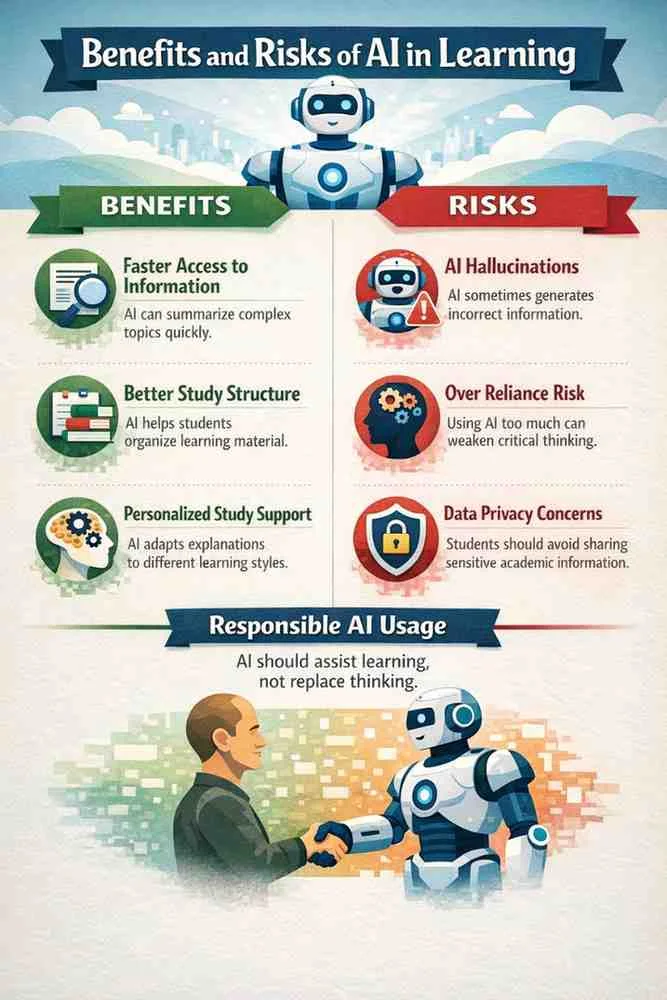
Benefits of AI in Learning
Artificial intelligence has gained attention in education because it offers practical advantages for both students and educators.
When used carefully, AI can improve the efficiency and structure of the learning process.
Improved Concept Understanding
Students often encounter concepts that feel confusing at first.
AI systems can generate alternative explanations, analogies, and examples. This allows students to approach the same concept from multiple perspectives.
If one explanation fails, another may succeed.
This flexibility helps students overcome one of the most common barriers in learning: misunderstanding the initial explanation.
Faster Access to Information
Searching through textbooks or academic sources can take time, especially when students are unsure where to begin.
AI systems can help summarize key ideas or explain unfamiliar terminology. This allows students to gain an initial understanding before exploring more detailed sources.
However, AI summaries should always be verified using trusted academic materials.
AI can introduce a topic, but it should not replace deeper reading.
Structured Study Support
Another advantage of AI learning systems is their ability to organize information.
Students often feel overwhelmed by large amounts of study material. AI tools can help break topics into smaller sections, create outlines, and suggest logical study sequences.
This structured approach improves productivity and helps students manage complex subjects more effectively.
Instead of approaching a subject randomly, learners follow a clearer path toward understanding.
Risks and Limitations of AI in Learning
Artificial intelligence can improve learning efficiency, but it is not a flawless system. Understanding its limitations is essential for students who want to use AI responsibly.
Ignoring these limitations can create academic risks and weaken long term learning skills.
AI Hallucinations and Incorrect Information
AI systems generate responses by predicting patterns from training data. Because of this, they sometimes produce answers that sound correct but are factually wrong.
This issue is commonly known as hallucination.
An AI system may:
• invent references
• misinterpret historical facts
• simplify scientific theories incorrectly
• provide outdated information
Students should always verify important information using trusted academic sources such as textbooks, peer reviewed articles, or instructor materials.
AI can help introduce a concept, but it should not be treated as a final academic authority.
Over Reliance on Artificial Intelligence
One of the biggest risks of AI supported learning is dependency.
If students rely on AI to generate explanations, solve problems, and summarize every chapter, they may gradually weaken essential academic skills.
These skills include:
• critical thinking
• analytical reasoning
• writing ability
• memory retention
Learning requires effort and active engagement. AI should assist learning, not remove the effort required to develop knowledge.
Students who maintain control of their learning process gain the most benefit from AI systems.
Data Privacy and Academic Information
Students often paste assignments, research drafts, and personal notes into AI tools without considering how that information may be stored.
Some AI platforms may retain user inputs for system improvement or data analysis. Policies differ between platforms.
Students should avoid sharing:
• confidential academic documents
• unpublished research material
• sensitive personal data
Understanding privacy policies is part of modern digital literacy.
Bias in AI Learning Systems
Artificial intelligence models are trained on large datasets collected from many sources. These datasets may contain biases or incomplete perspectives.
This can influence how AI systems explain topics related to culture, history, or social issues.
Students should approach AI explanations critically and compare them with academic sources whenever possible.
Critical evaluation remains one of the most important skills in education.
Can Artificial Intelligence Replace Traditional Learning Methods
The rapid growth of AI in education has raised an important question.
Can artificial intelligence replace traditional learning methods?
The short answer is no.
AI can enhance education, but it cannot replace the core elements of learning.
Education involves more than information delivery. It includes mentorship, discussion, collaboration, and the development of reasoning skills.
Teachers provide context, guidance, and real world experience that AI systems cannot replicate.
Artificial intelligence can assist with tasks such as generating practice questions or explaining concepts, but it cannot evaluate a student’s motivation, creativity, or intellectual growth.
Traditional learning methods such as classroom discussion, group projects, and instructor feedback remain essential.
The most effective educational model combines both approaches.
Teachers provide guidance and expertise.
Students actively engage with material.
AI tools assist with explanations and structured support.
This combination creates a more flexible and supportive learning environment.
The Future of AI Powered Learning
Artificial intelligence will continue shaping how education evolves in the coming years.
Educational institutions are already exploring new ways to integrate AI into digital learning systems.
Future developments may include:
AI learning companions that help students review material and generate practice exercises.
Advanced adaptive learning systems that adjust entire courses based on student progress.
AI supported research assistants that help students navigate large academic databases.
Learning analytics platforms that identify student strengths and weaknesses earlier.
These technologies aim to support personalized learning experiences.
However, technology alone does not define education.
Curiosity, discipline, and independent thinking will always remain essential parts of learning.
Artificial intelligence may change how students access knowledge, but the responsibility for understanding that knowledge will always belong to the learner.
Key Takeaways
Artificial intelligence is becoming an important part of modern learning environments.
Students now have access to systems that can explain concepts, generate practice questions, and organize study materials more efficiently than traditional tools.
However, AI should be used carefully.
It works best as a learning assistant rather than a replacement for independent thinking.
Students who combine AI support with critical thinking, verification, and disciplined study habits gain the greatest advantage.
Artificial intelligence does not replace learning.
It amplifies the learning process when used responsibly.
Refrence: Wikipedia, Google Scholar