

Why Artificial Intelligence Is Becoming Part of Daily Life
Not long ago, artificial intelligence sounded like something reserved for research labs or large technology companies.
Today it appears quietly in everyday tools that millions of people use without even noticing.
When someone unlocks their phone with facial recognition, asks a voice assistant for the weather, or receives movie recommendations on a streaming platform, they are interacting with artificial intelligence.
The shift happened gradually.
Advances in machine learning, data processing, and cloud computing made it possible for companies to integrate AI into real products and services. Instead of being an experimental technology, AI became a practical tool that improves speed, accuracy, and personalization.
Businesses quickly realized that AI can analyze information faster than traditional software. It can detect patterns in large amounts of data, automate repetitive processes, and assist humans in making better decisions.
This is why artificial intelligence is now present in many areas of daily life, including healthcare, finance, education, transportation, and digital communication.
Most people do not interact directly with complex AI systems. Instead, they experience the results through smarter apps, faster services, and more personalized digital experiences.
Understanding these real world AI applications helps explain why the technology has become one of the most influential innovations in modern computing.
The Shift From Research Labs to Everyday Tools
In the early stages of artificial intelligence development, AI systems were primarily used for research experiments or specialized industrial tasks.
Over time, companies began applying these technologies to consumer products.
Search engines started using AI to understand user intent.
Online stores used recommendation systems to suggest products.
Navigation apps began predicting traffic patterns using machine learning.
These changes made AI part of everyday digital infrastructure.
Today, many of the systems people rely on daily are powered by artificial intelligence behind the scenes.
Why Businesses Are Adopting AI Rapidly
Organizations across industries are investing in AI because it improves efficiency and decision making.
AI systems can process information at a scale that humans cannot easily manage. This allows companies to analyze customer behavior, detect trends, and automate routine tasks.
For example:
Retail companies use AI to predict product demand.
Banks use AI to detect suspicious financial activity.
Hospitals use AI tools to assist in medical image analysis.
The goal is not simply automation. It is better insights and faster responses.
This combination of data analysis and automation is what makes AI valuable in real world applications.
Real World AI Applications in Everyday Technology
Many of the most common uses of artificial intelligence appear in technologies people interact with daily.
These systems often operate quietly in the background, analyzing data and improving the performance of digital services.
From voice assistants to recommendation systems, AI plays a role in shaping the modern digital experience.
Smart Assistants and Voice Recognition
Voice assistants are one of the most recognizable examples of artificial intelligence in everyday life.
When someone asks a smart assistant to set a reminder, play music, or answer a question, several AI technologies are working together.
Speech recognition converts spoken language into text.
Natural language processing interprets the meaning of the request.
Machine learning systems generate an appropriate response.
This combination allows users to interact with technology through natural conversation rather than complex commands.
Voice assistants are commonly used for tasks such as:
setting reminders
checking weather updates
searching for information
controlling smart home devices
These systems continue improving as they learn from user interactions.
Recommendation Systems in Online Platforms
Another widely used AI application is the recommendation system.
Streaming services, online marketplaces, and social media platforms use machine learning algorithms to suggest content or products.
For example:
A streaming platform may recommend movies based on viewing history.
An online store may suggest products related to previous purchases.
A music platform may create personalized playlists.
These systems analyze large amounts of user behavior data to identify patterns.
The result is a more personalized experience that helps users discover content more easily.
AI in Navigation and Maps
Navigation apps provide another practical example of artificial intelligence in action.
When people check a map application to find the fastest route to a destination, the system analyzes several factors.
Current traffic conditions
Road closures
Historical traffic patterns
Distance and travel time
Machine learning models evaluate this information and calculate the most efficient route.
Some navigation systems can even predict traffic congestion before it occurs by analyzing historical travel patterns.
This ability to process real time data and predict outcomes is one of the most useful real world AI applications in transportation.

AI Applications in Business and Industry
Imagine a small online store owner checking their dashboard in the morning.
Orders came in overnight.
Customers asked questions through chat.
Marketing campaigns are running on social media.
Behind many of these processes, artificial intelligence is quietly helping businesses operate more efficiently.
Companies across industries use AI to analyze data, automate routine tasks, and understand customer behavior.
Instead of replacing employees, AI often works as a support system that handles repetitive analysis while humans focus on strategy and decision making.
AI in Marketing and Customer Insights
Marketing teams collect large amounts of data from websites, advertisements, and social media platforms.
Analyzing this data manually can take significant time.
AI powered analytics tools help identify patterns such as:
which products customers prefer
which advertisements perform best
what time users are most active online
For example, an AI system might analyze website activity and discover that visitors from a particular region respond better to specific marketing messages.
This allows businesses to adjust their campaigns and improve engagement.
AI can also help generate content ideas, analyze audience sentiment, and predict trends based on historical data.
AI in Customer Support Automation
Customer support is another area where artificial intelligence is widely used.
Businesses often receive repetitive questions such as:
Where is my order?
How do I return a product?
What are your business hours?
AI powered chat assistants can respond to these common questions instantly.
This improves response time while reducing the workload on human support teams.
More complex issues are still handled by human agents, but AI systems help manage the initial interaction and organize incoming requests.
AI in Business Decision Support
Modern businesses rely heavily on data.
Sales reports, customer feedback, inventory levels, and market trends all generate information that must be analyzed.
AI tools can process this information quickly and highlight useful insights.
For example:
A retail company might use AI to predict which products will be in high demand next season.
A logistics company may use AI to optimize delivery routes and reduce transportation costs.
These insights help managers make more informed decisions and adapt faster to market changes.
AI Applications in Healthcare
Healthcare is one of the fields where artificial intelligence is creating significant impact.
Hospitals, clinics, and research institutions are using AI to analyze medical data, assist doctors, and improve patient care.
Although AI does not replace medical professionals, it can support them by processing information quickly and identifying patterns that might otherwise be difficult to detect.
AI for Medical Image Analysis
Medical imaging technologies such as X rays, MRI scans, and CT scans produce large amounts of visual data.
Doctors often need to examine these images carefully to detect signs of disease or injury.
AI systems trained on large medical datasets can assist by analyzing these images and highlighting areas that may require attention.
For example, AI tools may help detect early signs of certain conditions in medical scans.
This allows doctors to focus on reviewing the results and making final clinical decisions.
AI in Diagnosis Support Systems
Artificial intelligence can also assist doctors during the diagnostic process.
Some systems analyze symptoms, medical history, and test results to suggest possible conditions.
These tools do not replace medical expertise. Instead, they act as decision support systems that provide additional insights.
Doctors still evaluate the results and determine the most appropriate treatment for each patient.
AI in Hospital Operations
Hospitals manage complex operations that involve scheduling staff, coordinating equipment, and handling patient records.
AI tools can help optimize these processes.
For example:
AI systems can predict patient admission trends and help hospitals allocate resources more effectively.
Some hospitals also use AI powered software to streamline administrative tasks such as appointment scheduling and record management.
By reducing administrative workload, healthcare staff can focus more time on patient care.
AI Applications in Education
A student sits down to study for an exam.
There are several chapters to review, notes to organize, and concepts that still feel confusing. In the past, solving these problems required searching through textbooks, watching long lectures, or asking a teacher for help.
Today, artificial intelligence is becoming a learning companion that helps students and educators manage information more effectively.
Many educational platforms now integrate AI to assist with studying, personalized learning, and academic research.
AI Learning Assistants
AI learning assistants can help explain topics, summarize lessons, and answer questions in simple language.
For example, a student studying physics might ask an AI system to explain a complex concept step by step.
The system analyzes the question and produces a simplified explanation that helps the student understand the topic more clearly.
These tools are especially useful when learners need quick clarification while studying independently.
AI Study Tools for Students
Artificial intelligence also supports practical study activities such as note organization and revision.
Students can use AI tools to:
summarize lecture notes
generate study outlines
create practice questions
organize research material
For example, a student might upload class notes and ask an AI tool to convert them into a structured summary.
This makes it easier to review key information before exams.
However, students should still verify important details from official study materials.
AI Personalized Learning Systems
One of the most interesting applications of AI in education is personalized learning.
Traditional classrooms often follow a single pace for all students. AI based learning systems can adapt to individual progress.
For example, if a student struggles with a specific concept, the system may recommend additional exercises or simplified explanations.
If the student learns quickly, the system may suggest more advanced topics.
This adaptive approach helps learners move at a pace that fits their understanding.
AI Applications in Finance
Financial institutions process enormous volumes of data every day.
Transactions, customer activity, investment records, and market movements all generate complex datasets.
Artificial intelligence helps banks and financial organizations analyze this information quickly and identify patterns that would be difficult to detect manually.
Fraud Detection Systems
One of the most common real world AI applications in finance is fraud detection.
Banks and payment platforms monitor millions of transactions daily. AI systems analyze these transactions in real time to detect unusual behavior.
For example, an AI system may flag a transaction if it appears inconsistent with a customer’s typical spending pattern.
If a credit card is suddenly used in a different country or for an unusual purchase, the system may trigger a security alert.
This allows financial institutions to respond quickly and reduce fraud risks.
AI Risk Analysis
Financial organizations also use AI to evaluate risk.
When someone applies for a loan or credit card, the institution must analyze several factors such as income history, credit behavior, and repayment patterns.
AI models can analyze these factors and estimate the probability of repayment.
These predictions help institutions make faster and more informed lending decisions.
Automated Financial Insights
AI tools are also used to analyze financial data and generate insights.
For example:
Investment platforms may use AI to analyze market trends and highlight possible opportunities.
Personal finance apps may use AI to categorize spending patterns and suggest ways to improve budgeting.
These systems transform complex financial information into clear insights that help users make better decisions.
Limitations of Real World AI Applications
Artificial intelligence can improve efficiency, automate processes, and help analyze large amounts of information. However, it is important to understand that AI systems still have limitations.
These systems work by learning patterns from data. They do not truly understand information in the same way humans do.
Because of this, AI should be used as a support tool rather than a complete replacement for human decision making.
Accuracy and Data Dependence
AI systems rely heavily on the quality of the data used to train them.
If the data is incomplete, outdated, or biased, the system may produce inaccurate results.
For example, an AI model used for predictions may generate incorrect insights if it learns from limited or flawed data.
This is why human review remains essential in many AI assisted processes.
Professionals often use AI to analyze information quickly, but final decisions are still verified by experts.
Ethical and Privacy Concerns
Many real world AI applications involve processing personal or sensitive information.
For example:
customer purchase behavior
medical records
financial transactions
Organizations using AI must follow strict privacy policies and data protection standards.
Users should also understand how their data is collected and processed by digital platforms.
If a service relies on AI powered systems, it is helpful to review the platform’s privacy documentation to understand how information is handled.
Human Oversight Is Still Necessary
AI can identify patterns and generate insights, but it does not replace human judgment.
In fields such as healthcare, finance, and legal analysis, AI is often used as a decision support system rather than a decision maker.
Doctors still interpret medical results.
Financial analysts still review market data.
Business leaders still make strategic decisions.
The most effective real world AI applications combine machine efficiency with human expertise.
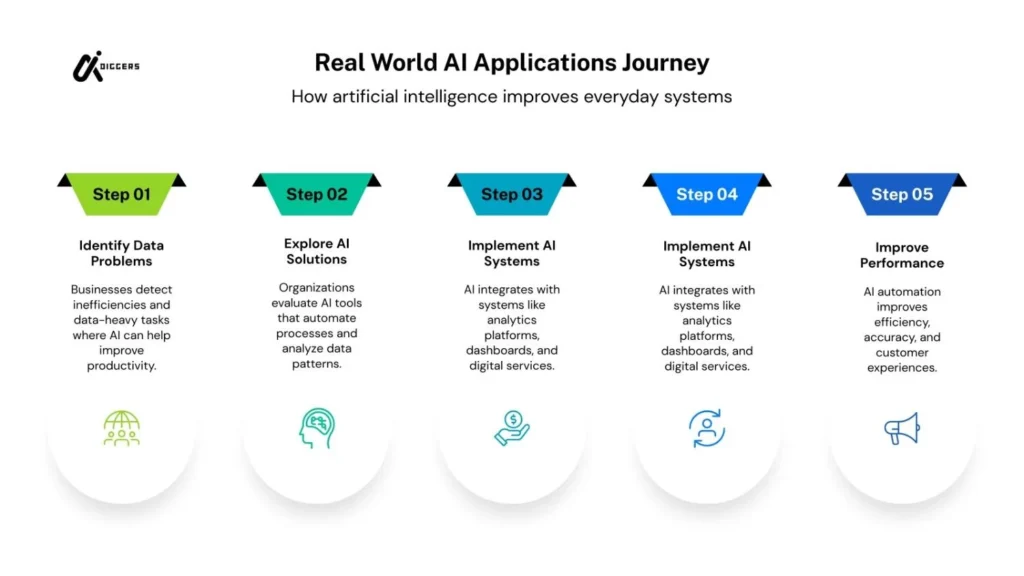
The Future of Real World AI Applications
Artificial intelligence is already present in many industries, but its adoption is still expanding.
As technology improves, AI systems are becoming more capable of analyzing complex information, automating workflows, and assisting professionals in specialized tasks.
Many organizations are investing in AI to improve productivity, customer experience, and operational efficiency.
Expanding Use Across Industries
In the coming years, AI is expected to appear in even more sectors.
Transportation companies are exploring AI driven logistics systems.
Manufacturing industries are using AI to improve production efficiency.
Retail companies are adopting AI for inventory prediction and customer personalization.
These applications help organizations operate faster and respond more effectively to changing conditions.
AI as a Productivity Partner
Rather than replacing human roles, many experts see AI evolving into a productivity partner.
Professionals will increasingly use AI to handle repetitive tasks such as data analysis, content drafting, and information organization.
This allows people to focus on creative thinking, strategic planning, and complex problem solving.
Responsible AI Development
As artificial intelligence becomes more widely used, responsible development becomes increasingly important.
Developers and organizations are working to improve:
accuracy of AI models
transparency of algorithms
ethical data usage
privacy protection
Building trust in AI systems will be essential for long term adoption.
When used responsibly, artificial intelligence can continue to improve how people work, learn, communicate, and solve problems.
FAQ
What are real world AI applications?
Real world AI applications are practical uses of artificial intelligence in everyday technologies and industries. Examples include recommendation systems, voice assistants, fraud detection systems, medical image analysis, and personalized learning platforms.
How is AI used in everyday life?
AI is used in many daily tools such as navigation apps, streaming platforms, online shopping recommendations, voice assistants, and smart devices.
Which industries use artificial intelligence the most?
Industries such as healthcare, finance, retail, marketing, transportation, and education use AI widely to analyze data, automate tasks, and improve decision making.
What are examples of AI in business?
Businesses use AI for customer support automation, marketing analytics, demand prediction, fraud detection, and workflow automation.
How is AI used in healthcare?
AI assists healthcare professionals by analyzing medical images, supporting diagnosis systems, managing hospital operations, and analyzing patient data.
Can AI help students in education?
Yes. AI can help students summarize study materials, explain complex topics, generate practice questions, and organize research notes.
How do banks use artificial intelligence?
Banks use AI to detect fraudulent transactions, analyze financial risk, automate customer service, and generate financial insights.
Is AI used in navigation apps?
Yes. Navigation systems use AI to analyze traffic conditions, predict travel times, and suggest efficient routes based on real time data.
Are AI systems always accurate?
No. AI systems can sometimes produce inaccurate results if the data they rely on is incomplete or outdated. Human review is often required.
What is the future of artificial intelligence applications?
AI is expected to expand across more industries, supporting automation, data analysis, and decision making while working alongside human expertise.
Refrence: Wikipedia, Google Scholar