

What AI Tools Are and Why They Matter
A few years ago, artificial intelligence sounded like something reserved for scientists, engineers, and large technology companies.
Today, it is part of everyday digital work.
Writers use AI to draft content.
Students use AI to summarize research.
Businesses use AI to analyze data and automate repetitive tasks.
The tools that make these capabilities possible are called AI tools.
An AI tool is a software application that uses artificial intelligence technologies such as machine learning, natural language processing, or computer vision to perform tasks that normally require human intelligence.
Instead of manually analyzing information or producing content, users can rely on AI systems to assist with these processes.
These tools are becoming increasingly popular because they help people save time, improve productivity, and handle complex tasks more efficiently.
How AI Tools Work
Most AI tools rely on machine learning models that analyze large datasets to identify patterns.
For example, a writing tool may analyze thousands of text examples to understand how sentences are structured.
When a user enters a prompt, the system generates text based on patterns learned from that data.
Similarly, AI research tools analyze large volumes of information and summarize key points.
Design tools may generate images based on descriptive instructions.
Although the underlying technology can be complex, modern AI tools are designed to be simple to use. Many platforms allow users to interact with AI systems using natural language prompts or easy to understand interfaces.
Why AI Tools Are Growing Rapidly
The growth of AI tools is driven by several factors.
First, advances in machine learning have made AI systems more capable and reliable.
Second, cloud computing has made these tools accessible through web platforms and mobile applications.
Finally, businesses and individuals are increasingly looking for ways to improve efficiency.
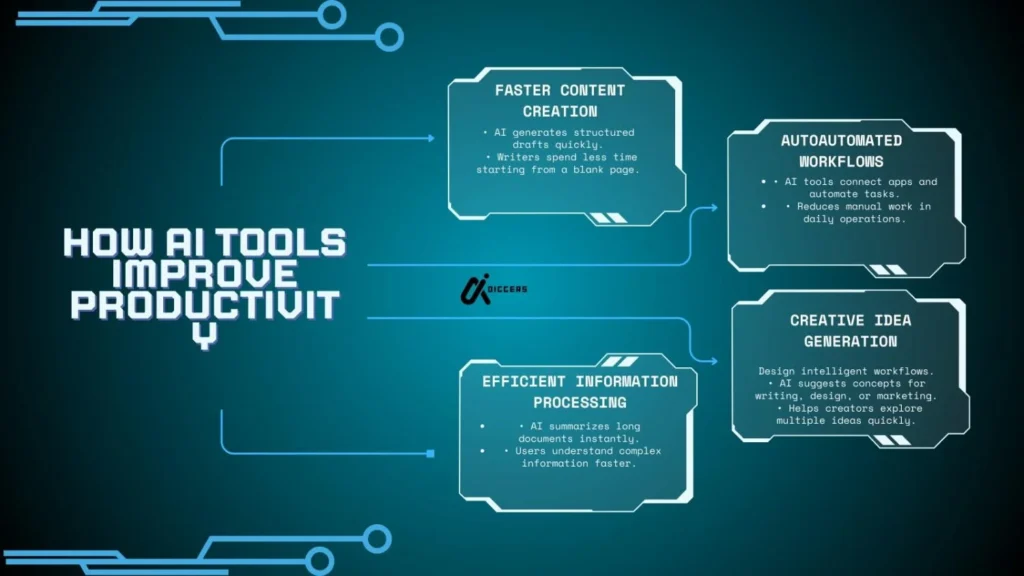
AI tools help reduce repetitive work, assist with creative tasks, and support decision making by analyzing information quickly.
Because of these advantages, artificial intelligence software is now used in many fields including marketing, education, design, business operations, and research.
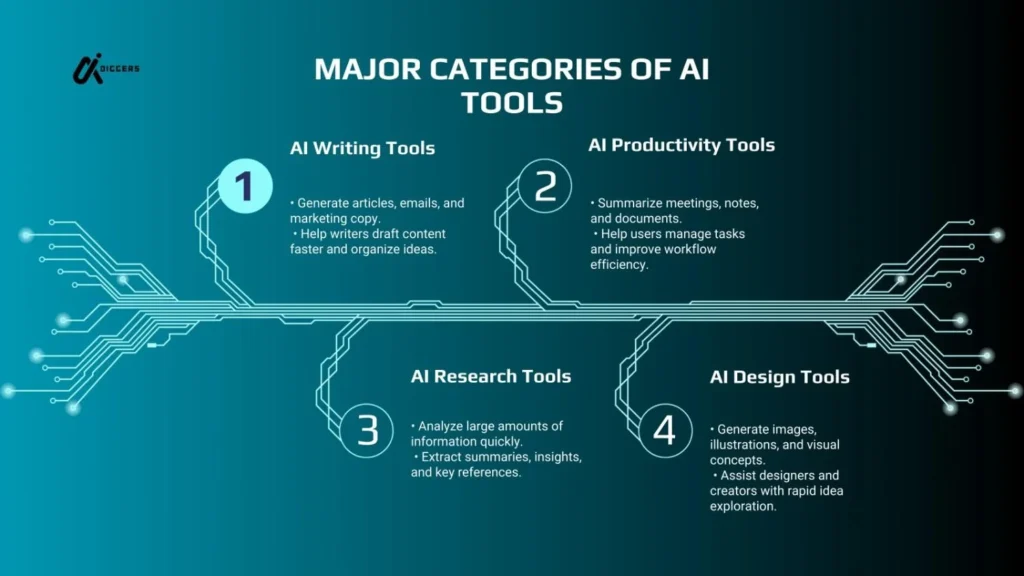
Categories of AI Tools
Artificial intelligence tools serve many different purposes.
Instead of focusing on a single type of task, the AI software ecosystem now includes tools designed for writing, productivity, research, design, and automation.
Understanding these categories can help users identify the tools that match their needs.
AI Writing Tools
AI writing tools are among the most widely used artificial intelligence applications.
These platforms assist users with tasks such as generating article drafts, summarizing documents, creating marketing copy, and improving grammar.
Writers, bloggers, and marketers often use these tools to speed up content production while maintaining consistency.
AI writing systems typically rely on natural language processing models that analyze text patterns and generate human like responses.
AI Productivity Tools
Productivity tools powered by artificial intelligence help people manage tasks, organize information, and automate workflows.
These tools may summarize meetings, generate action items, or organize research notes.
Professionals often use productivity tools to manage large volumes of information and improve efficiency.
For example, AI assistants can analyze documents, generate summaries, and help users quickly understand key insights.
AI Research Tools
Research tools use artificial intelligence to analyze documents, extract information, and summarize complex topics.
Students, analysts, and researchers frequently rely on these tools to review large amounts of content more efficiently.
Instead of manually reading hundreds of pages of material, AI systems can highlight important concepts and provide summaries.
This allows users to focus on understanding the information rather than simply locating it.
AI Design and Creative Tools
Artificial intelligence is also transforming creative industries.
Design tools powered by AI can generate images, illustrations, and visual content based on descriptive prompts.
These tools allow creators to experiment with different visual ideas without needing advanced design skills.
For example, users may describe a scene or concept, and the AI system generates visual interpretations based on that description.
AI Automation Tools
Automation tools use artificial intelligence to connect tasks and systems.
These platforms allow users to create workflows that automatically perform repetitive actions such as sending emails, organizing data, or updating records.
Businesses and freelancers often use automation tools to streamline processes and reduce manual work.
By connecting different applications, AI automation systems help users create efficient digital workflows.
Best AI Writing Tools
AI writing tools are among the most widely adopted artificial intelligence applications. These tools assist with generating text, summarizing documents, drafting emails, and organizing ideas.
Writers, marketers, students, and professionals often use AI writing tools to speed up the content creation process while maintaining clarity and structure.
Instead of starting with a blank page, users can provide a prompt and receive a draft that can be refined and improved.
ChatGPT
One of the most recognized AI writing tools is OpenAI’s conversational system.
ChatGPT helps users generate text, answer questions, brainstorm ideas, and summarize information.
People commonly use it for tasks such as:
writing article drafts
summarizing research
creating outlines
generating email responses
Because it supports natural language prompts, the tool is accessible to beginners as well as professionals.
Grammarly
Another widely used writing assistant is Grammarly.
Grammarly focuses on improving the clarity and quality of written communication.
The tool analyzes grammar, spelling, tone, and sentence structure.
Many professionals use Grammarly when writing emails, reports, and documents to ensure that their writing remains clear and professional.
Jasper
Jasper AI is a platform designed primarily for marketing teams and content creators.
The tool helps generate marketing copy, blog posts, product descriptions, and advertising text.
Businesses often use Jasper when producing large volumes of marketing content because it can generate structured drafts quickly.
These writing tools demonstrate how artificial intelligence can assist users during the creative process while still requiring human review and editing.
Best AI Productivity Tools
Productivity tools powered by artificial intelligence focus on helping people manage information and organize their work more efficiently.
These tools often analyze documents, summarize discussions, and help users manage tasks.
Instead of manually reviewing long documents or meeting notes, AI systems can highlight important details and simplify information.
Notion AI
Notion AI is integrated into the popular productivity platform Notion.
The tool helps users organize notes, summarize documents, and generate content inside their workspace.
Teams frequently use Notion AI to structure project documentation, create summaries, and organize information within collaborative workspaces.
Otter.ai
Otter.ai is designed to capture and summarize conversations during meetings.
The system records discussions and converts speech into text transcripts.
After the meeting ends, the tool provides a written summary and key points.
This allows teams to review important information without manually taking notes during discussions.
Motion
Motion is designed to help users organize their schedules.
The platform analyzes tasks, deadlines, and calendar events to automatically plan work schedules.
By organizing tasks intelligently, the system helps users focus on completing important work instead of managing complex schedules.
These productivity tools show how artificial intelligence can simplify information management and support more efficient work routines.
Best AI Research Tools
Research often requires reading large amounts of information, reviewing documents, and identifying key insights. Artificial intelligence tools can assist with this process by analyzing documents, summarizing information, and highlighting important concepts.
Students, analysts, and professionals frequently use AI research tools to review complex material more efficiently.
Perplexity
Perplexity AI is designed to function as an intelligent research assistant.
Instead of returning a list of links like traditional search engines, the system generates direct answers supported by cited sources.
Researchers often use the platform to:
explore complex topics
summarize articles
find referenced information quickly
This approach helps users locate reliable information without manually reviewing many search results.
Elicit
Elicit is designed to help researchers explore academic literature.
The platform analyzes research papers and extracts useful insights such as summaries, key findings, and relevant citations.
Students and academics often use Elicit when studying scientific topics or reviewing research publications.
Scite
Scite focuses on analyzing scientific citations.
The tool helps researchers understand how studies are referenced within academic literature.
For example, the system identifies whether a paper supports or challenges the findings of another study.
This helps users evaluate the credibility and influence of research sources.
AI research tools allow users to explore complex topics more efficiently by reducing the time required to locate and analyze information.
Best AI Design and Creative Tools
Artificial intelligence is also transforming creative work such as graphic design, image generation, and visual content production.
AI powered creative tools allow users to generate visual ideas quickly, even without advanced design skills.
These tools are widely used by designers, marketers, and content creators.
Midjourney
Midjourney is known for generating high quality visual artwork based on text prompts.
Users describe a scene, concept, or style, and the system generates images that match the description.
Artists and designers often use Midjourney to experiment with visual ideas or create concept art.
DALL·E
DALL·E is another popular image generation system.
The tool converts text descriptions into images, allowing users to create illustrations, concept art, and creative visuals.
This type of technology demonstrates how generative AI can support creative exploration.
Canva Magic Studio
Canva Magic Studio integrates AI powered design features into the popular design platform Canva.
These features assist with tasks such as generating design layouts, creating images, and editing visual content.
Because Canva already provides an accessible design environment, its AI features are often used by beginners and small businesses.
AI design tools make creative work more accessible by allowing users to generate ideas quickly and experiment with different visual styles.
How to Choose the Right AI Tool
The number of artificial intelligence tools available today is growing rapidly. While this provides many opportunities, it can also make it difficult to decide which tools are worth using.
Choosing the right AI tool depends largely on the type of task you want to accomplish.
Some tools focus on writing and content creation, while others help with productivity, research, or design. Understanding the purpose of each tool can help users select the most useful option for their needs.
Identify Your Primary Use Case
Before selecting a tool, it is helpful to define the main problem you want to solve.
For example:
content creators may need writing assistance
students may need research and summarization tools
business professionals may require automation or productivity software
By identifying the main objective, users can narrow their choices to tools designed for that specific purpose.
Evaluate Features and Ease of Use
AI tools vary widely in complexity.
Some platforms provide simple interfaces that allow users to generate results with a short prompt, while others offer advanced customization and workflow integration.
When comparing tools, it can be useful to consider:
ease of use
available features
integration with other software
pricing structure
Many AI platforms offer free trials or limited free versions that allow users to test the software before committing to a subscription.
Start with a Small Set of Tools
Because AI technology evolves quickly, it is not necessary to use many tools at once.
Many professionals begin by using one or two tools that solve their most common tasks.
Over time, they may explore additional platforms that support their workflow.
Starting with a small number of tools helps users learn how artificial intelligence can improve their daily work without becoming overwhelmed.
Limitations of AI Tools
Although AI tools can improve efficiency and support creative work, they also have limitations.
Understanding these limitations helps users apply artificial intelligence responsibly.
Accuracy and Reliability
AI systems generate results based on patterns found in training data.
Because of this, the information produced by AI tools may sometimes contain errors or incomplete details.
Users should always review AI generated content and verify important information before relying on it for professional use.
Privacy and Data Considerations
Some AI platforms process user input through cloud based systems.
When working with sensitive information such as business data or personal documents, it is important to review the privacy policies of the platform.
Organizations often establish guidelines that determine how AI tools should be used when handling confidential data.
Human Judgment Remains Essential
Artificial intelligence can assist with analysis, research, and content generation, but it does not replace human decision making.
Professionals still need to interpret results, evaluate context, and ensure accuracy.
For this reason, AI tools are best viewed as assistants rather than replacements for human expertise.
The Future of AI Tools
Artificial intelligence software continues to evolve as research and technology advance.
Over the coming years, AI tools are expected to become more capable and integrated into everyday digital systems.
More Intelligent Digital Assistants
Future AI assistants may become more capable of handling complex tasks.
Instead of responding to simple prompts, these systems may help organize projects, manage communication, and analyze information across multiple platforms.
Integration with Everyday Software
Many companies are integrating artificial intelligence features directly into existing productivity platforms.
Word processors, design tools, and collaboration software are increasingly including AI powered capabilities.
This integration allows users to access AI assistance without switching between different applications.
Expansion Across Industries
Artificial intelligence tools are already being used in areas such as marketing, education, research, healthcare, and design.
As technology develops, new applications will likely appear in many industries.
While the capabilities of AI tools will continue to expand, responsible use and human oversight will remain important elements of successful implementation.
FAQ
What are the best AI tools?
Some of the most widely used AI tools include conversational assistants like ChatGPT, productivity tools such as Notion AI, research platforms like Perplexity, and creative tools such as Midjourney and DALL·E.
What are AI tools used for?
AI tools help perform tasks such as writing content, summarizing documents, generating images, analyzing data, and automating workflows.
Are there free AI tools available?
Yes. Many AI platforms provide free versions with limited features. These versions allow users to experiment with AI tools before upgrading to paid plans.
Which AI tools are best for beginners?
Beginner friendly AI tools typically include platforms with simple interfaces such as ChatGPT, Canva AI tools, and productivity assistants integrated into existing software.
How do AI tools work?
AI tools use technologies such as machine learning and natural language processing to analyze patterns in data and generate useful responses or predictions.
Refrence: Wikipedia, Google Scholar