
Introduction: The Rise of AI in Universities
Higher education has always evolved alongside technology.
Libraries replaced handwritten manuscripts.
Online databases replaced physical research archives.
Digital learning platforms expanded access to academic resources.
Today, another transformation is taking place.
Artificial intelligence is gradually becoming part of university education.
Students are using AI tools to understand complex topics and organize research material. Professors are exploring AI assisted grading systems and digital tutoring platforms. Universities are analyzing student learning patterns to improve academic programs.
This shift is not about replacing traditional education.
It is about enhancing how universities support teaching, research, and student learning.
Higher education institutions handle enormous volumes of information. Research papers, academic journals, lecture materials, and student data all contribute to a complex academic environment.
Artificial intelligence helps manage this complexity by identifying patterns, organizing information, and supporting decision making.
However, the integration of AI in universities also raises important questions.
How should AI support academic learning?
What role should it play in research?
How can universities protect academic integrity while adopting new technology?
Understanding these questions is essential for students, educators, and institutions navigating the future of higher education.
Artificial intelligence is not redefining the purpose of universities.
Instead, it is introducing new tools that can support learning, research, and academic administration when used responsibly.
What Artificial Intelligence Means for Higher Education
Artificial intelligence in higher education refers to digital systems that assist teaching, research, and institutional operations by analyzing data and generating insights.
These systems are usually built on machine learning models that recognize patterns in large datasets.
In universities, AI may appear in many forms.
Learning platforms may use AI to recommend study materials.
Research systems may help analyze large academic datasets.
Administrative platforms may predict student enrollment patterns.
These technologies operate behind the scenes in many modern educational systems.
AI as Academic Infrastructure
Universities manage thousands of students, courses, research projects, and academic records.
Artificial intelligence can support this environment by processing information more efficiently than traditional systems.
For example, learning analytics platforms can track student performance patterns and identify areas where additional academic support may be required.
Similarly, research platforms may use AI to help scholars discover relevant academic papers within large databases.
In this sense, AI functions as part of the academic infrastructure that supports modern universities.
Difference Between AI Learning Tools and University Systems
It is important to distinguish between personal AI learning tools and institutional AI systems.
Students often use AI tools individually to clarify concepts, summarize reading material, or organize study schedules.
Universities, however, use AI at a broader scale.
Institutional systems may analyze course data, evaluate teaching effectiveness, or recommend learning pathways based on academic performance trends.
While student tools focus on individual productivity, university level AI systems focus on improving educational structures and academic decision making.
Both types of AI play different roles in the higher education ecosystem.
Understanding this distinction helps clarify how artificial intelligence fits within university learning environments.
How Universities Use AI in Teaching
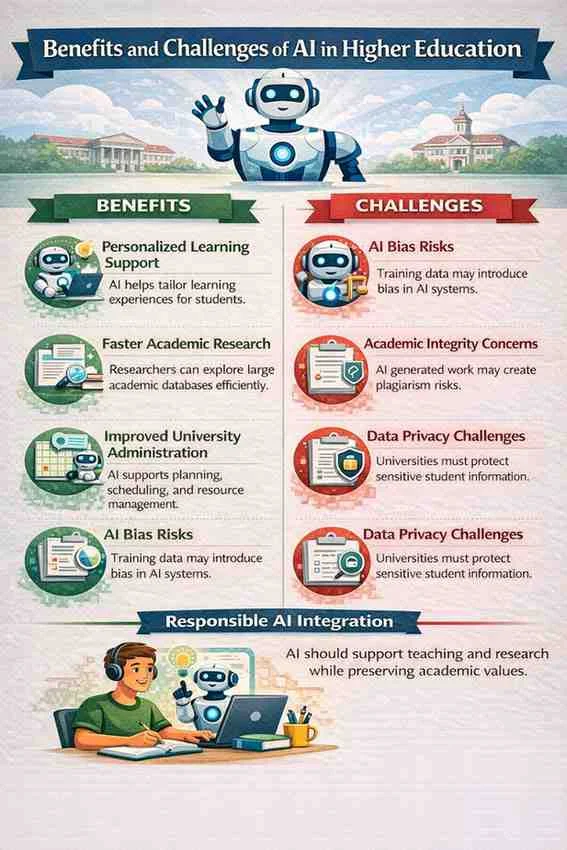
Artificial intelligence is gradually becoming part of university teaching environments. While traditional lectures and classroom discussions remain essential, many institutions are exploring AI systems that can support students during the learning process.
These systems are designed to assist teaching rather than replace educators.
AI Tutoring Systems
Some universities are experimenting with AI powered tutoring systems that help students review course material outside the classroom.
These systems can explain difficult topics, generate practice questions, and provide guidance when students struggle with specific concepts.
For example, if a student repeatedly answers a question incorrectly in an online learning platform, the system may provide additional explanations or suggest related learning material.
This allows students to receive support even when instructors are not immediately available.
However, these systems are not substitutes for human tutors or professors. They function best as supplementary learning tools.
AI Assisted Learning Platforms
Learning management systems used by universities often include AI features that personalize the learning experience.
These platforms analyze how students interact with course materials and recommend additional readings, exercises, or lectures based on learning patterns.
For example, if a student spends extra time reviewing a particular topic, the system may suggest additional resources related to that subject.
This type of adaptive learning support helps students focus on areas where they need improvement.
Automated Feedback Systems
Another area where AI is being explored in higher education is automated feedback.
Some digital learning platforms use AI to provide immediate feedback on quizzes, practice assignments, or writing drafts.
Instead of waiting for graded assignments, students can receive early guidance on how to improve their work.
For example, AI systems may highlight unclear arguments in an essay draft or suggest improvements in structure.
This feedback can help students refine their ideas before submitting final assignments.
AI in Academic Research
Research is one of the most important activities within universities.
Professors and students spend significant time reviewing academic literature, analyzing data, and developing new knowledge.
Artificial intelligence can assist researchers by helping them navigate large volumes of information more efficiently.
Research Discovery Tools
Modern research databases often contain millions of academic articles and publications.
AI systems can help researchers identify relevant papers by analyzing keywords, citations, and research themes.
For example, a student working on a thesis may use an AI supported research tool to discover related studies that might otherwise be difficult to locate.
This can save time during the early stages of research.
Literature Analysis
Reading academic literature is often time consuming.
AI tools can summarize research papers and highlight key findings, allowing researchers to quickly understand the main ideas of a publication before reading the full document.
This approach can help students identify which sources are most relevant to their research topics.
However, summaries should never replace reading the original research. Academic papers often contain detailed arguments and methodological explanations that summaries cannot fully capture.
Data Processing Support
Many university research projects involve analyzing large datasets.
Artificial intelligence can assist by identifying patterns, organizing data, and supporting statistical analysis.
For example, in fields such as economics, engineering, or health sciences, AI systems may help researchers explore relationships within complex datasets.
These tools accelerate research processes, but interpretation and conclusions must always come from human researchers.
AI for University Administration
Artificial intelligence in higher education is not limited to teaching and research. Universities are also exploring how AI systems can improve administrative processes.
Managing a large academic institution involves coordinating thousands of students, courses, schedules, and records. Artificial intelligence can assist administrators by analyzing patterns and supporting decision making.
Student Performance Analytics
Many universities collect data related to student performance, course completion rates, and learning behavior.
AI powered analytics systems can examine this data to identify trends. For example, if students consistently struggle with a particular course, administrators may investigate whether the curriculum needs adjustment or whether additional academic support should be provided.
These insights help universities improve the learning experience by responding to real patterns rather than assumptions.
Course Recommendation Systems
Some institutions are experimenting with AI systems that recommend courses based on a student’s academic history and interests.
These systems analyze previous course selections, grades, and degree requirements to suggest suitable classes for future semesters.
The goal is to help students navigate complex academic programs more easily while ensuring they meet graduation requirements.
However, final decisions still belong to academic advisors and students.
Enrollment and Resource Planning
Universities must also predict how many students will enroll in different programs each year.
AI systems can analyze historical data and demographic trends to estimate future enrollment patterns.
This helps universities plan classroom space, allocate teaching resources, and manage budgets more effectively.
In this context, artificial intelligence becomes a decision support tool that helps institutions operate more efficiently.
Benefits of AI in Higher Education
Artificial intelligence has attracted attention in universities because it offers several advantages when integrated responsibly into academic systems.
These benefits extend to students, educators, researchers, and administrators.
Improved Learning Personalization
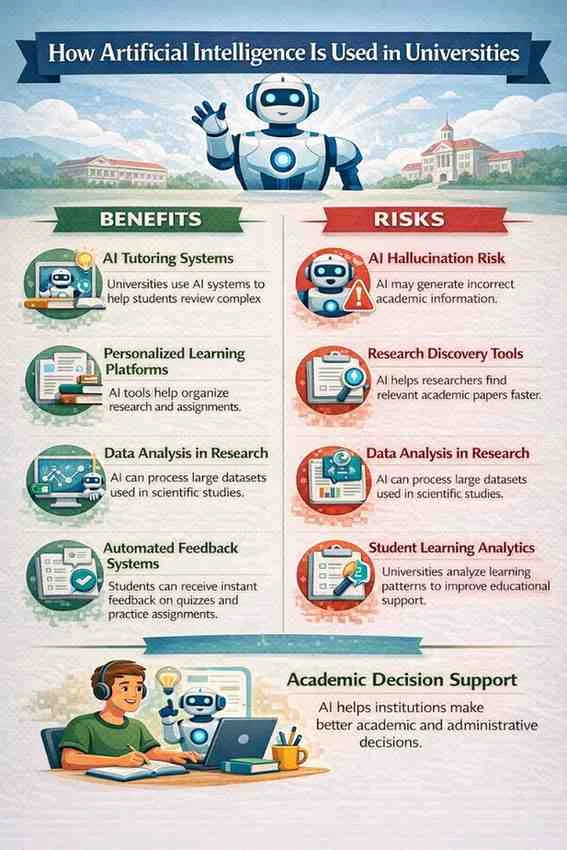
AI systems can help tailor educational content to individual learning needs.
Instead of delivering identical learning material to every student, AI assisted platforms can recommend additional resources or exercises based on a student’s learning progress.
This personalized approach can help students focus on areas where they need the most improvement.
Faster Research Exploration
Academic research often requires exploring large volumes of literature.
AI tools can assist by identifying relevant research papers, summarizing key findings, and suggesting connections between studies.
This can help students and researchers spend less time searching for information and more time analyzing ideas.
Enhanced Institutional Decision Making
Universities operate complex systems involving admissions, academic programs, and student support services.
AI analytics can provide insights that help institutions understand student behavior and learning patterns.
For example, universities may use these insights to design better support programs for students who face academic challenges.
Support for Large Learning Communities
Modern universities often serve thousands of students across multiple programs.
AI systems can help manage these large communities by supporting learning platforms, providing automated feedback, and organizing educational resources.
When integrated carefully, artificial intelligence helps universities scale educational support while maintaining academic standards.
Risks and Challenges of AI in Higher Education
While artificial intelligence offers several advantages for universities, it also introduces challenges that institutions must address carefully.
Higher education depends on academic integrity, reliable research practices, and responsible use of information. Integrating AI systems into this environment requires thoughtful policies and oversight.
AI Bias in Academic Systems
Artificial intelligence systems learn patterns from the data used to train them.
If the training data contains bias or incomplete perspectives, the AI system may produce outputs that reflect those limitations.
In academic environments, this could influence how information is interpreted or how recommendations are generated.
Universities must evaluate AI systems carefully to ensure that they support fair and balanced learning environments.
Academic Integrity Concerns
One of the most widely discussed challenges is academic honesty.
Students now have access to AI systems capable of generating structured text, summaries, and explanations. Without clear guidelines, this can create confusion about what constitutes acceptable academic work.
Many universities are developing policies that clarify how AI tools may be used in assignments, research, and coursework.
These policies aim to ensure that students continue to develop independent thinking and original analysis.
Data Privacy and Security
Universities store large amounts of sensitive information, including academic records, research data, and personal student details.
When AI systems analyze this data, institutions must ensure that privacy protections remain strong.
Strict data management practices are necessary to prevent misuse or unauthorized access.
Protecting academic information is a critical responsibility when implementing AI technologies in higher education.
The Future of AI in Universities
Artificial intelligence is expected to play a larger role in university education over the coming years.
Educational institutions are exploring how AI can enhance learning experiences, support research, and improve administrative processes.
Future developments may include more advanced learning platforms that adapt to individual student progress.
AI tutoring systems may help students review course material and practice complex concepts outside the classroom.
Research tools powered by artificial intelligence may assist scholars in analyzing large datasets or discovering connections between academic studies.
However, the future of higher education will not be defined solely by technology.
Universities remain places where students engage in discussion, develop critical thinking skills, and collaborate with educators and peers.
Artificial intelligence can support these processes, but it cannot replace the intellectual curiosity and human interaction that drive academic discovery.
The most effective educational systems will combine traditional academic values with carefully integrated technology.
Key Takeaways
Artificial intelligence is gradually transforming how universities support teaching, research, and academic administration.
AI systems can help personalize learning experiences, improve research efficiency, and assist institutions in managing complex educational environments.
At the same time, universities must address challenges related to academic integrity, data privacy, and responsible use of technology.
Artificial intelligence should enhance education rather than replace the fundamental principles of learning.
When used thoughtfully, AI becomes a tool that helps universities expand knowledge, support students, and strengthen research.
The future of higher education will likely involve a balanced combination of human expertise and intelligent digital systems.
FAQ
What is AI in higher education?
AI in higher education refers to the use of artificial intelligence systems in universities to support teaching, research, and administrative processes. These systems analyze data, assist learning platforms, and help institutions manage academic resources more efficiently.
How do universities use artificial intelligence?
Universities use AI for several purposes including tutoring systems, research assistance, learning analytics, automated feedback tools, and administrative decision support.
Can AI improve university learning?
Artificial intelligence can improve university learning by providing personalized learning support, faster access to information, and tools that help students organize research and study material.
What are the risks of AI in higher education?
MAjor risks include academic integrity concerns, potential bias in AI systems, misinformation generated by AI models, and data privacy challenges related to student and research information.
Will AI replace professors in universities?
No. Artificial intelligence can support teaching and learning, but it cannot replace professors. Human educators provide mentorship, critical thinking guidance, and academic expertise that AI systems cannot replicate.
How can universities use AI responsibly?
Universities can use AI responsibly by creating clear policies for AI usage, protecting student data, monitoring academic integrity, and ensuring that technology supports learning rather than replacing human instruction.
Refrence: Wikipedia , Google Scholar